
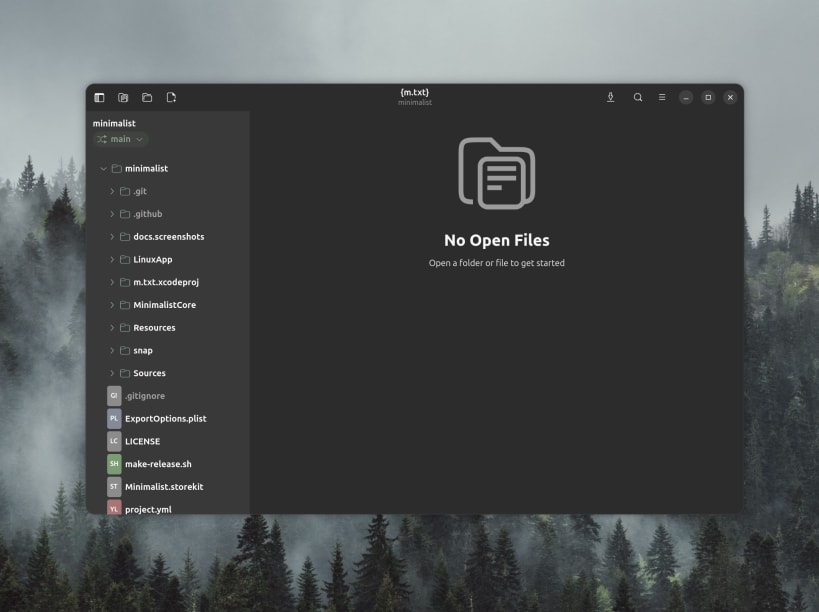


A minimalist text editor. No AI, no bs, no plugins or agents.
Syntax highlighting, multi-tab editing, a file-tree sidebar, and git branch awareness — sharing its document engine with the macOS app.
Syntax highlighting for 180+ languages, with light and dark themes A beautiful reader view for Markdown (tables, task lists, code blocks) and AsciiDoc Inline completions drawn from your own file — no cloud, no AI Line numbers, word wrap, custom fonts, and a minimap for the bird's-eye view of the source file(s)
Stay focused on the developing
Zen mode strips the window down to just your text A quick-search palette takes you straight to any file Optional glass window style and quiet background patterns — drifting sand, ripples, mist, stars
Never lose a thought with built-in revision history
Automatic revision history: autosave snapshots, plus a commit every time you save Compare revisions with a unified diff and restore any version locally before committing to git Session restore brings back your folder, tabs, and place on app or computer restart
For developers, by a developer
Open a folder and browse it in a compact file tree Switch and create git branches; browse any file's commit history Built-in viewers for PDFs, images, video, and audio — and a hex view for everything else
Yours, privately
No accounts, no tracking. Telemetry free.
m.Txt is a passion project — built to be the calm, instant editor its developer wanted every day, due to the frustration with many of the other editors out there being bloated with extras that wasn't asked for or wanted.
You are about to open
Do you wish to proceed?
Thank you for your report. Information you provided will help us investigate further.
There was an error while sending your report. Please try again later.
Snaps are applications packaged with all their dependencies to run on all popular Linux distributions from a single build. They update automatically and roll back gracefully.
Snaps are discoverable and installable from the Snap Store, an app store with an audience of millions.
Snap can be installed from the command line on openSUSE Leap 15.x and Tumbleweed.
You need first add the snappy repository from the terminal. Choose the appropriate command depending on your installed openSUSE flavor.
Tumbleweed:
sudo zypper addrepo --refresh https://download.opensuse.org/repositories/system:/snappy/openSUSE_Tumbleweed snappy
Leap 15.x:
sudo zypper addrepo --refresh https://download.opensuse.org/repositories/system:/snappy/openSUSE_Leap_15.6 snappy
If needed, Swap out openSUSE_Leap_15. for, openSUSE_Leap_16.0 if you’re using a different version of openSUSE.
With the repository added, import its GPG key:
sudo zypper --gpg-auto-import-keys refresh
Finally, upgrade the package cache to include the new snappy repository:
sudo zypper dup --from snappy
Snap can now be installed with the following:
sudo zypper install snapd
You then need to either reboot, logout/login or source /etc/profile to have /snap/bin added to PATH.
Additionally, enable and start both the snapd and the snapd.apparmor services with the following commands:
sudo systemctl enable --now snapd
sudo systemctl enable --now snapd.apparmor
To install m-txt, simply use the following command:
sudo snap install m-txt
Browse and find snaps from the convenience of your desktop using the snap store snap.

Interested to find out more about snaps? Want to publish your own application? Visit snapcraft.io now.