

RepoBeam is a free Git client for Linux and Windows that helps you understand, preview and safely complete the Git operations that usually cause uncertainty.
Before/After history previews
When an action changes history — going back to an earlier commit, combining commits or repairing a diverged branch — RepoBeam shows the commit graph as it is now and as it is expected to look afterwards, and lists what changes. Nothing happens until you confirm. RepoBeam avoids rewriting published history by default and creates a private recovery point before rewriting local commits.
Guided conflict resolution
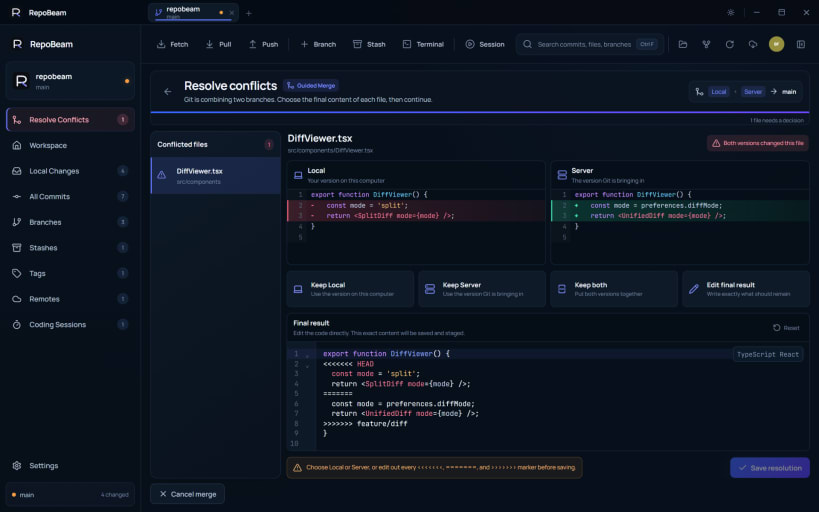
When a merge, rebase, cherry-pick or revert stops on a conflict, RepoBeam shows both versions side by side with a short explanation of where each came from. Keep one, keep both, or edit the final result, then continue or cancel without leaving the app. A file can't be saved while conflict markers remain.
Coding Sessions for AI-assisted work
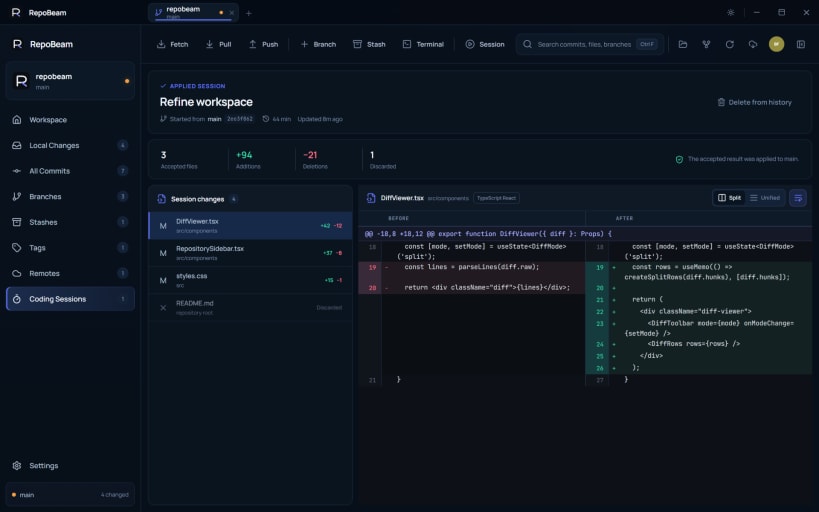
Start a Coding Session before an agent or editor changes your code. RepoBeam keeps the work on a dedicated session branch, lets you review every changed file, and applies only what you accept. A session is a Git review workflow, not a security sandbox.
Everything you expect from a daily Git client
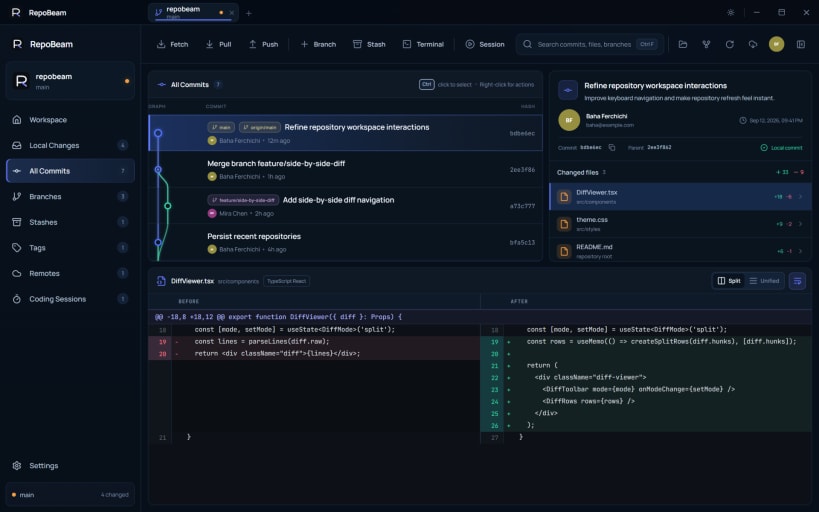
Commit history, staging of whole files or single hunks, code and image diffs, branches, stashes, tags, remotes, repository tabs, terminal access, and light and dark themes.
Free, with no account
RepoBeam is free to download. There is no RepoBeam account and no telemetry, and RepoBeam doesn't upload your repositories to RepoBeam servers. It runs the Git already installed on your system and uses your SSH agent and credential helpers.
Requires Git to be installed, for example: sudo apt install git
Guides and privacy: https://repobeam.com
You are about to open
Do you wish to proceed?
Thank you for your report. Information you provided will help us investigate further.
There was an error while sending your report. Please try again later.
Snaps are applications packaged with all their dependencies to run on all popular Linux distributions from a single build. They update automatically and roll back gracefully.
Snaps are discoverable and installable from the Snap Store, an app store with an audience of millions.
Snap can be installed from the command line on openSUSE Leap 15.x and Tumbleweed.
You need first add the snappy repository from the terminal. Choose the appropriate command depending on your installed openSUSE flavor.
Tumbleweed:
sudo zypper addrepo --refresh https://download.opensuse.org/repositories/system:/snappy/openSUSE_Tumbleweed snappy
Leap 15.x:
sudo zypper addrepo --refresh https://download.opensuse.org/repositories/system:/snappy/openSUSE_Leap_15.6 snappy
If needed, Swap out openSUSE_Leap_15. for, openSUSE_Leap_16.0 if you’re using a different version of openSUSE.
With the repository added, import its GPG key:
sudo zypper --gpg-auto-import-keys refresh
Finally, upgrade the package cache to include the new snappy repository:
sudo zypper dup --from snappy
Snap can now be installed with the following:
sudo zypper install snapd
You then need to either reboot, logout/login or source /etc/profile to have /snap/bin added to PATH.
Additionally, enable and start both the snapd and the snapd.apparmor services with the following commands:
sudo systemctl enable --now snapd
sudo systemctl enable --now snapd.apparmor
To install RepoBeam, simply use the following command:
sudo snap install repobeam
Browse and find snaps from the convenience of your desktop using the snap store snap.

Interested to find out more about snaps? Want to publish your own application? Visit snapcraft.io now.