


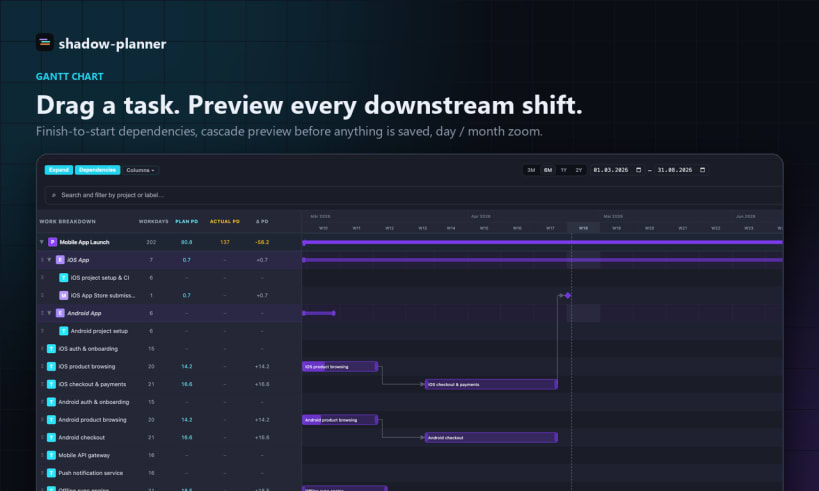
Shadow Planner combines a full project management tool (Gantt, resource utilization, portfolio view) with an LLM assistant that understands your data and helps you think.
Chat-driven planning & controlling — ask questions, get summaries, make changes, and approve destructive operations through a conversational interface scoped to your active scenario.
Planner Agent — paste a Markdown brief and the agent drafts a full project structure (epics, tasks, assignments) for you to review before anything is written to the database.
Scenarios & Snapshots — work in isolated planning scenarios; snapshot any state for a point-in-time record; save reusable templates to bootstrap new scenarios in seconds.
Local-first, your choice — default provider is a local Ollama install (no data leaves your machine). Switch to Anthropic Claude or OpenAI ChatGPT in settings if you don't run a local LLM.
Multiple scenarios — maintain separate planning worlds (baseline, optimistic, re-org, ...) and switch between them instantly.
You are about to open
Do you wish to proceed?
Thank you for your report. Information you provided will help us investigate further.
There was an error while sending your report. Please try again later.
Snaps are applications packaged with all their dependencies to run on all popular Linux distributions from a single build. They update automatically and roll back gracefully.
Snaps are discoverable and installable from the Snap Store, an app store with an audience of millions.
Snapd can be installed from Manjaro’s Add/Remove Software application (Pamac), found in the launch menu. From the application, search for snapd, select the result, and click Apply.
Alternatively, snapd can be installed from the command line:
sudo pacman -S snapd
Once installed, the systemd unit that manages the main snap communication socket needs to be enabled:
sudo systemctl enable --now snapd.socket
To enable classic snap support, enter the following to create a symbolic link between /var/lib/snapd/snap and /snap:
sudo ln -s /var/lib/snapd/snap /snap
Either log out and back in again, or restart your system, to ensure snap’s paths are updated correctly.
To install shadow-planner, simply use the following command:
sudo snap install shadow-planner
Browse and find snaps from the convenience of your desktop using the snap store snap.

Interested to find out more about snaps? Want to publish your own application? Visit snapcraft.io now.