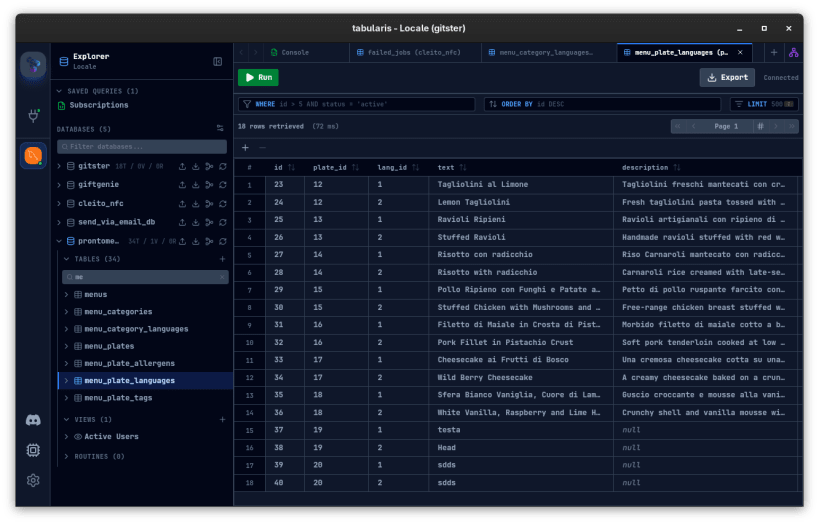
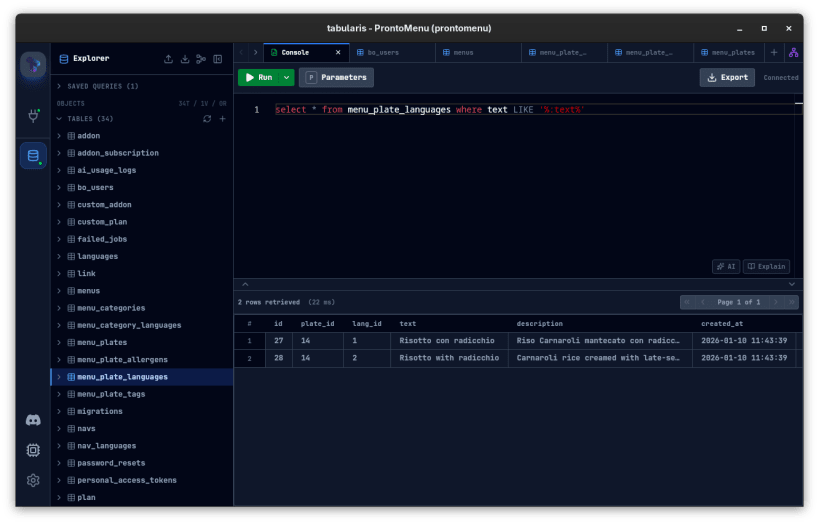
Tabularis is a free, open-source desktop database client for PostgreSQL, MySQL/MariaDB, and SQLite. Built with Rust (Tauri v2) and React, it is fast, lightweight, and designed for everyday SQL work.
SQL Notebooks: combine SQL and Markdown cells with inline charts, cross-cell variables, parameters, and export to HTML/CSV/JSON.
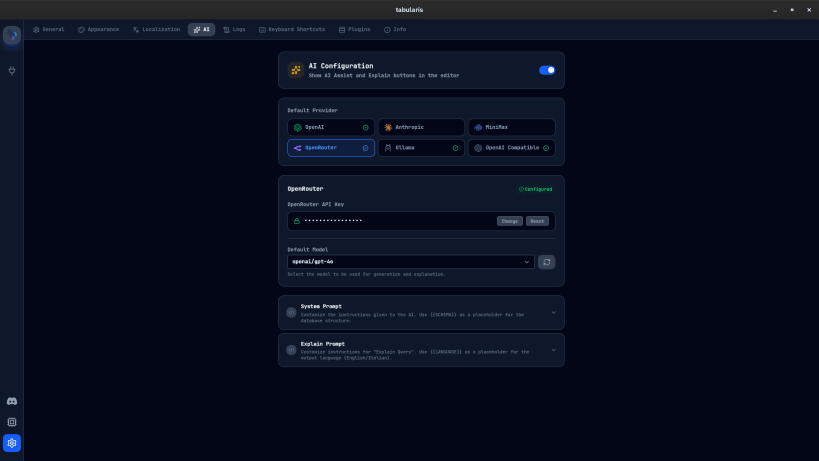
AI-Powered SQL Assistant: generate SQL from natural language, explain queries, and get optimization suggestions. Supports OpenAI, Claude, Ollama (local), OpenRouter, and any OpenAI-compatible API.
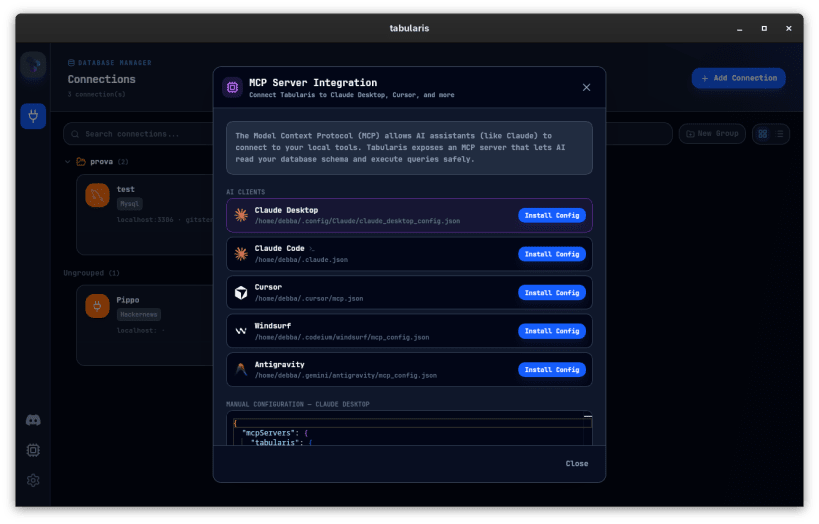
MCP Server: built-in Model Context Protocol server for AI agent integration with Claude Desktop, Claude Code, Cursor, and Windsurf.
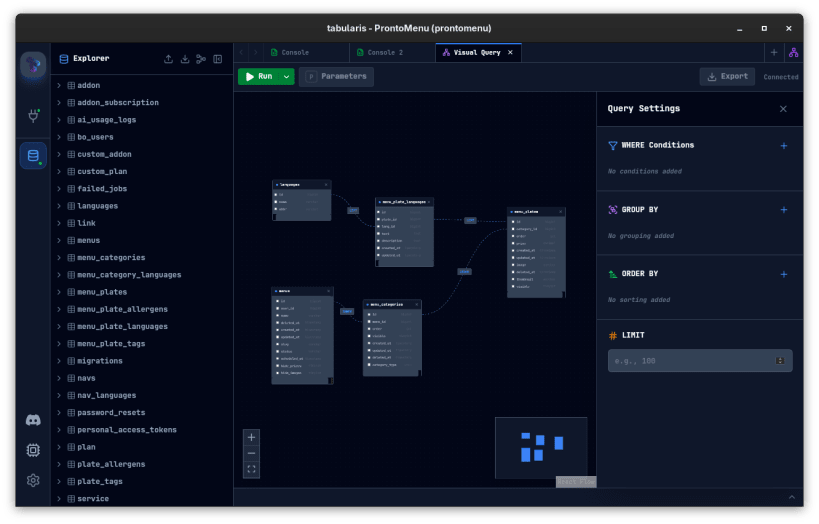
Visual Query Builder: drag-and-drop interface for JOINs, filters, aggregates, and sorting with real-time SQL generation.
Plugin System: add any database driver (DuckDB, ClickHouse, MongoDB, etc.) using JSON-RPC plugins in any language.
Also includes: Monaco-based SQL editor with smart autocomplete, high-performance virtualized data grid with inline editing, ER diagram visualization, SSH tunneling, system keychain credential storage, split view, SQL dump/import, 10+ themes, customizable keyboard shortcuts, and multi-language support (EN, IT, ES, ZH).
Website: https://tabularis.dev Source: https://github.com/debba/tabularis
You are about to open
Do you wish to proceed?
Thank you for your report. Information you provided will help us investigate further.
There was an error while sending your report. Please try again later.
Snaps are applications packaged with all their dependencies to run on all popular Linux distributions from a single build. They update automatically and roll back gracefully.
Snaps are discoverable and installable from the Snap Store, an app store with an audience of millions.
If you’re running Ubuntu 16.04 LTS (Xenial Xerus) or later, including Ubuntu 18.04 LTS (Bionic Beaver) and Ubuntu 20.04 LTS (Focal Fossa), you don’t need to do anything. Snap is already installed and ready to go.
For versions of Ubuntu between 14.04 LTS (Trusty Tahr) and 15.10 (Wily Werewolf), as well as Ubuntu flavours that don’t include snap by default, snap can be installed from the Ubuntu Software Centre by searching for snapd.
Alternatively, snapd can be installed from the command line:
sudo apt update
sudo apt install snapd
Either log out and back in again, or restart your system, to ensure snap’s paths are updated correctly.
To install tabularis, simply use the following command:
sudo snap install tabularis
Browse and find snaps from the convenience of your desktop using the snap store snap.

Interested to find out more about snaps? Want to publish your own application? Visit snapcraft.io now.