
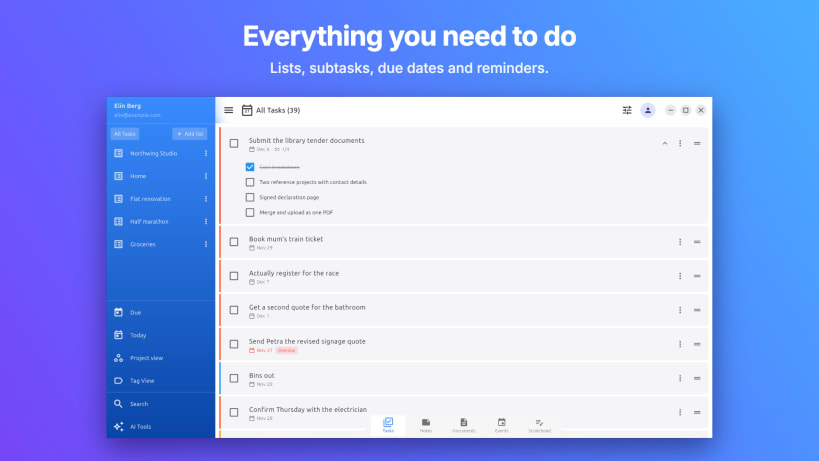



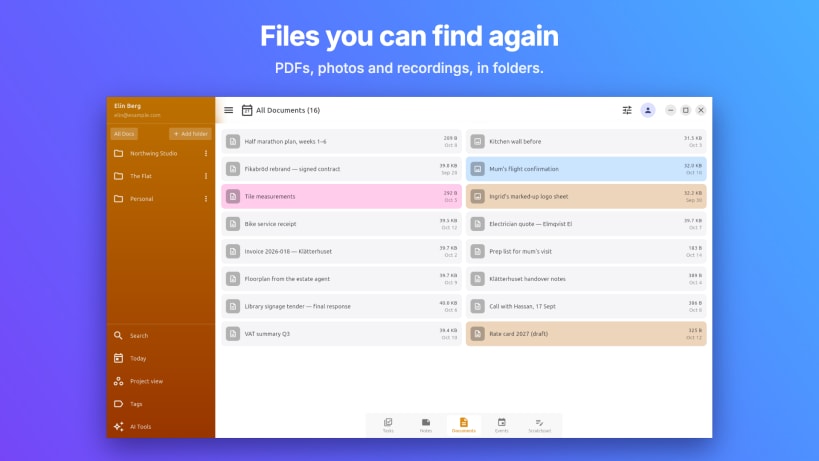
You probably have a to-do app, a notes app, a calendar, a folder called "misc" and a chat with yourself full of things to remember. TASKjiq is one app for all of that. It is free on the computer you install it on, with no account and no subscription; only the parts that need a server cost money. There are no ads, your data is not sold or shown to advertisers, and without an account it never leaves your computer.
• Tasks: lists, subtasks, due dates, priorities, tags, repeats and reminders. Type "call the bank tomorrow at 9" and the date fills itself in. • Notes: proper formatted text, with images, exported to PDF or Markdown. • Events: a calendar by day, week, month or agenda. Drag a task onto it and it becomes a block as long as you estimated. • Documents: photos, recordings, videos, PDFs, anything, in lists and folders, with previews. • Scratchpad: pages for whatever has no shape yet, a line of text, a sketch, a voice memo. One click turns a page into tasks, a note or documents.
Today shows your events and what is due, overdue first. One search covers everything, projects cross modules, any two items can be linked, Ctrl+N captures a thought before it escapes, and closing the window keeps TASKjiq in the tray so reminders still arrive. Deleted items wait in the trash for six months.
Leaving is easy: export the whole account as a zip of CSV, JSON, Markdown and your files as they were. Arriving is easy too: import your tasks from Todoist, Google Tasks or Microsoft To Do.
A paid plan adds the parts that need a server: sync with your other devices and the browser, sharing lists by email, cloud storage for documents, and AI helpers that read text only and come with an Undo.
You are about to open
Do you wish to proceed?
Thank you for your report. Information you provided will help us investigate further.
There was an error while sending your report. Please try again later.
Snaps are applications packaged with all their dependencies to run on all popular Linux distributions from a single build. They update automatically and roll back gracefully.
Snaps are discoverable and installable from the Snap Store, an app store with an audience of millions.
Snap can be installed from the command line on openSUSE Leap 15.x and Tumbleweed.
You need first add the snappy repository from the terminal. Choose the appropriate command depending on your installed openSUSE flavor.
Tumbleweed:
sudo zypper addrepo --refresh https://download.opensuse.org/repositories/system:/snappy/openSUSE_Tumbleweed snappy
Leap 15.x:
sudo zypper addrepo --refresh https://download.opensuse.org/repositories/system:/snappy/openSUSE_Leap_15.6 snappy
If needed, Swap out openSUSE_Leap_15. for, openSUSE_Leap_16.0 if you’re using a different version of openSUSE.
With the repository added, import its GPG key:
sudo zypper --gpg-auto-import-keys refresh
Finally, upgrade the package cache to include the new snappy repository:
sudo zypper dup --from snappy
Snap can now be installed with the following:
sudo zypper install snapd
You then need to either reboot, logout/login or source /etc/profile to have /snap/bin added to PATH.
Additionally, enable and start both the snapd and the snapd.apparmor services with the following commands:
sudo systemctl enable --now snapd
sudo systemctl enable --now snapd.apparmor
To install TASKjiq - Tasks, Notes & Events, simply use the following command:
sudo snap install taskjiq

Browse and find snaps from the convenience of your desktop using the snap store snap.

Interested to find out more about snaps? Want to publish your own application? Visit snapcraft.io now.