

Directory Size Profiler
Install latest/stable of Directory Size Profiler
Ubuntu 16.04 or later?
Make sure snap support is enabled in your Desktop store.
Install using the command line
sudo snap install directory-size-profilerDon't have snapd? Get set up for snaps.
Details for Directory Size Profiler
Package name
- directory-size-profiler
License
- MIT
Last updated
- 13 November 2026 - latest/stable
Report a Snap Store violation
Report Directory Size Profiler for a Snap Store violation
Snap Store Violation Report submitted successfully
Thank you for your report. Information you provided will help us investigate further.
Error submitting report
There was an error while sending your report. Please try again later.
Share this snap
Generate an embeddable card to be shared on external websites.
Directory Size Profiler - Hierarchical Folder Disk Usage Report
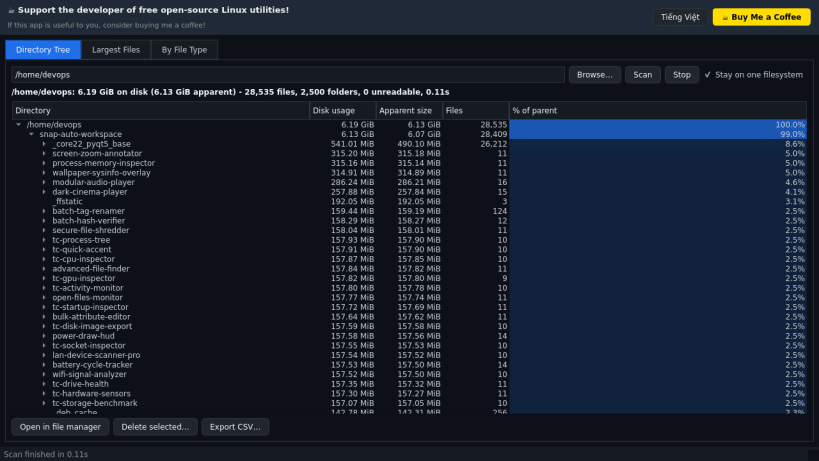
Directory Size Profiler is a graphical disk-usage reporter that works like the du command. A lightweight Linux alternative to the Sysinternals DU utility for finding what fills a folder.
Features:
- Scans any folder (default: your home) with real filesystem calls, counting disk blocks actually used, apparent size, file counts and hard links once.
- Expandable directory tree with sizes and percent-of-parent shading.
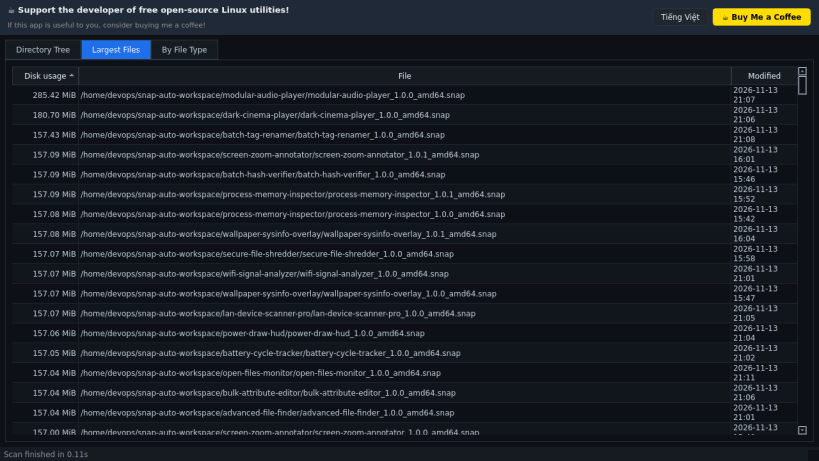
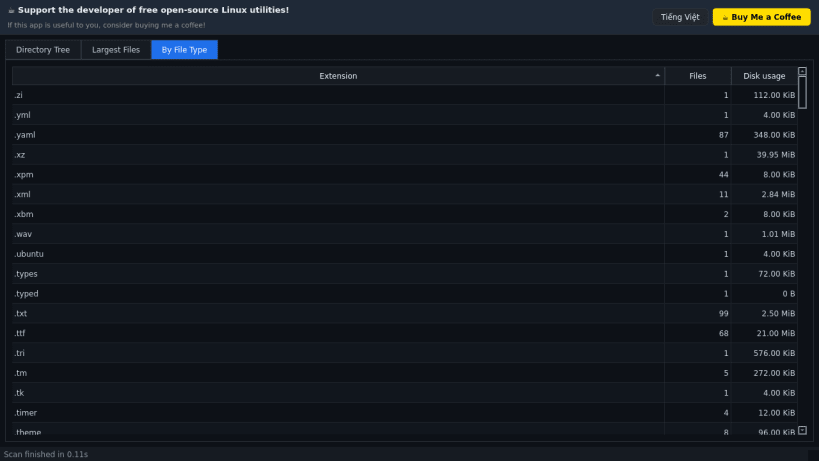
- Largest files list and per-extension usage report.
- Open a folder in your file manager, delete a selected folder (with confirmation) and export CSV.
- Optional stay-on-one-filesystem mode. Folders the sandbox or permissions cannot read are counted as unreadable.
Disclaimer: This project is an independent open-source tool and is not affiliated with, sponsored by, or endorsed by Microsoft Corporation or Sysinternals.
| Revision | Channel | Version | Build | Commit | Download SBOM |
|---|
The build and commit information is derived from build infrastructure records.
Install Directory Size Profiler on your Linux distribution
Choose your Linux distribution to get detailed installation instructions. If yours is not shown, get more details on the installing snapd documentation.


