

Add Flatpak
Add Flatpak is a small setup helper for Ubuntu desktop systems.
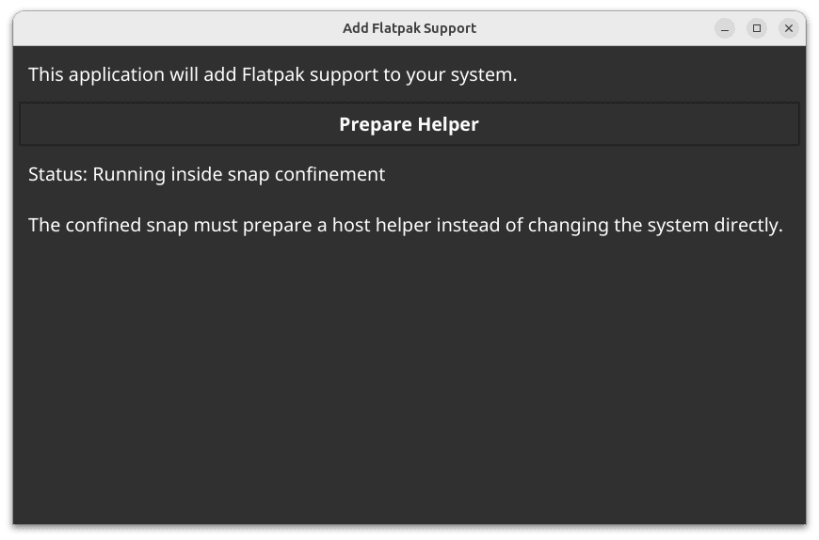
The confined snap prepares a user-launched helper. The helper then runs at the user request, outside snap confinement so it can clearly explain and perform the host package-management steps needed to install Flatpak and enable Flathub.
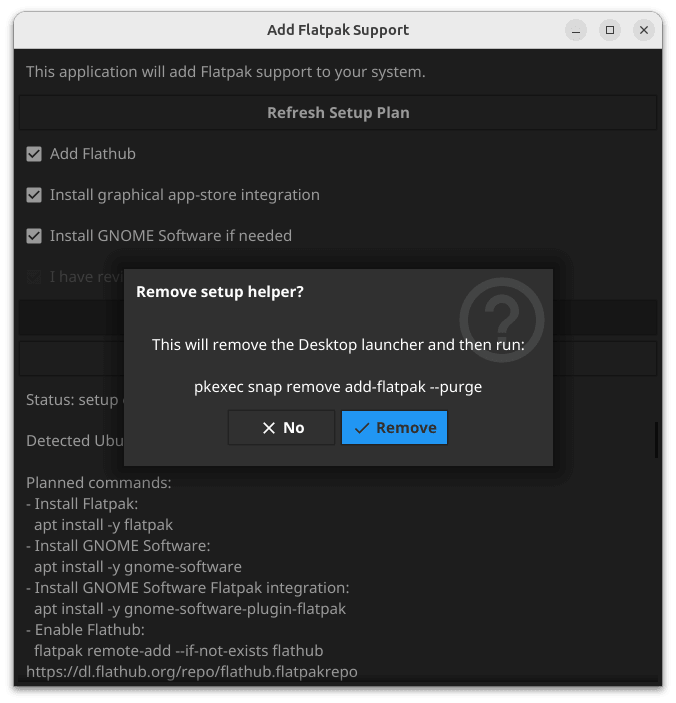
Its job is simple: help a user install Flatpak support, optionally add Flathub, optionally install graphical software-store integration, validate the result, and then remove itself when it is no longer needed.
Who This Is For
This app is intended for Ubuntu desktop users who do not want to copy and paste terminal commands from a website.
It is especially aimed at fresh Ubuntu installs where Flatpak is not already installed.
What It Does
On a supported Ubuntu system, Add Flatpak can:
flatpakgnome-software-plugin-flatpak on GNOME or Ubuntu Desktop;plasma-discover-backend-flatpak on KDE Plasma;What It Will Not Do
Add Flatpak is deliberately cautious.
apt on Fedora, Red Hat, immutable systems, or other non-Ubuntu systems.gnome-software during normal cleanup, because that may have existed before Add Flatpak was used.Supported Systems
This beta build currently allows setup on:
Other Ubuntu releases and non-Ubuntu distributions are blocked for now.
Why There Are Two Steps
Add Flatpak is packaged as a strictly confined snap.
That is good for safety, but it means the first app launch cannot directly change the host system with apt install or system Flatpak remote commands.
The app therefore uses two steps:
Add Flatpak Initial Setup This is the snap app. It prepares a Desktop launcher.
Enable Flatpak This is the Desktop launcher created by the first step. It runs the same app from the snap mount without the snap runtime environment, so it can clearly ask for permission and perform host setup.
This is why the user sees an initial setup window, then a Desktop icon named Enable Flatpak.
You are about to open
Do you wish to proceed?
Thank you for your report. Information you provided will help us investigate further.
There was an error while sending your report. Please try again later.
Snaps are applications packaged with all their dependencies to run on all popular Linux distributions from a single build. They update automatically and roll back gracefully.
Snaps are discoverable and installable from the Snap Store, an app store with an audience of millions.
Snap is available for Red Hat Enterprise Linux (RHEL) 8 and RHEL 7, from the 7.6 release onward.
The packages for RHEL 7, RHEL 8, and RHEL 9 are in each distribution’s respective Extra Packages for Enterprise Linux (EPEL) repository. The instructions for adding this repository diverge slightly between RHEL 7, RHEL 8 and RHEL 9, which is why they’re listed separately below.
The EPEL repository can be added to RHEL 9 with the following command:
sudo dnf install https://dl.fedoraproject.org/pub/epel/epel-release-latest-9.noarch.rpm
sudo dnf upgrade
The EPEL repository can be added to RHEL 8 with the following command:
sudo dnf install https://dl.fedoraproject.org/pub/epel/epel-release-latest-8.noarch.rpm
sudo dnf upgrade
The EPEL repository can be added to RHEL 7 with the following command:
sudo rpm -ivh https://dl.fedoraproject.org/pub/epel/epel-release-latest-7.noarch.rpm
Adding the optional and extras repositories is also recommended:
sudo subscription-manager repos --enable "rhel-*-optional-rpms" --enable "rhel-*-extras-rpms"
sudo yum update
Snap can now be installed as follows:
sudo yum install snapd
Once installed, the systemd unit that manages the main snap communication socket needs to be enabled:
sudo systemctl enable --now snapd.socket
To enable classic snap support, enter the following to create a symbolic link between /var/lib/snapd/snap and /snap:
sudo ln -s /var/lib/snapd/snap /snap
Either log out and back in again or restart your system to ensure snap’s paths are updated correctly.
To install Add Flatpak, simply use the following command:
sudo snap install add-flatpak
Browse and find snaps from the convenience of your desktop using the snap store snap.

Interested to find out more about snaps? Want to publish your own application? Visit snapcraft.io now.