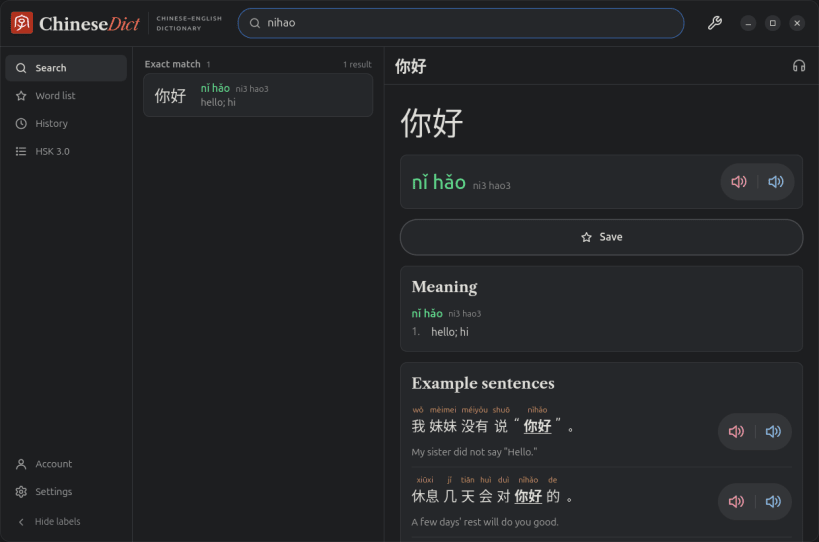
ChineseDict is a Chinese–English dictionary for people learning Mandarin. The whole dictionary is inside the app, so searching and opening entries need no connection.
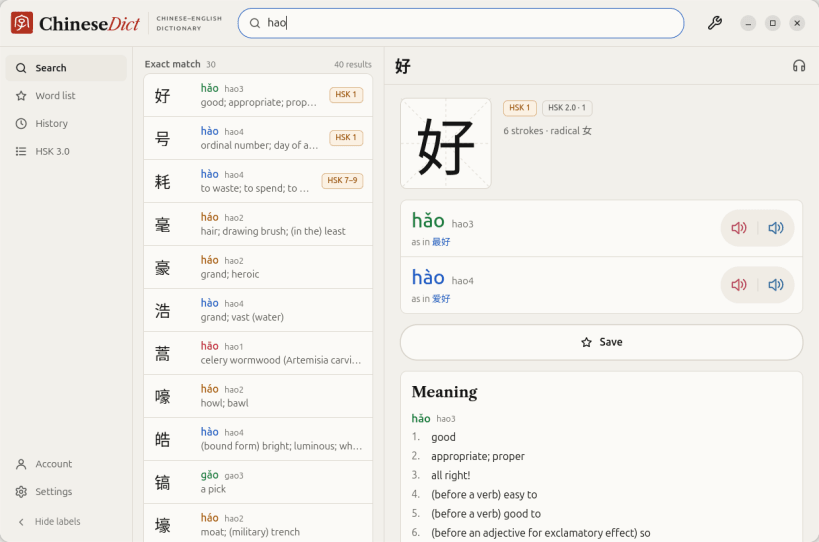
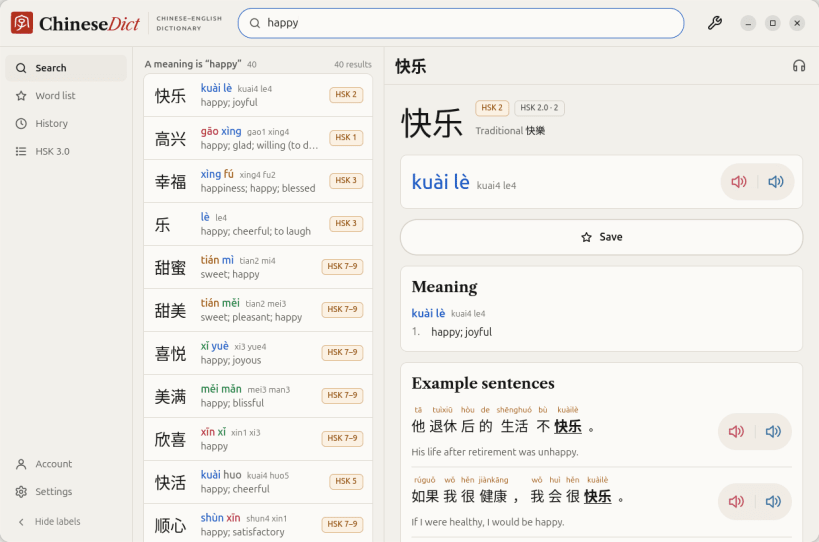
Search by characters, pinyin with or without tone marks, tone numbers, or English. nihao, nǐ hǎo, ni3hao3 and even a mis-toned ni2hao4 all find 你好. Results come grouped: the exact match first, then words that start with or contain what you typed.
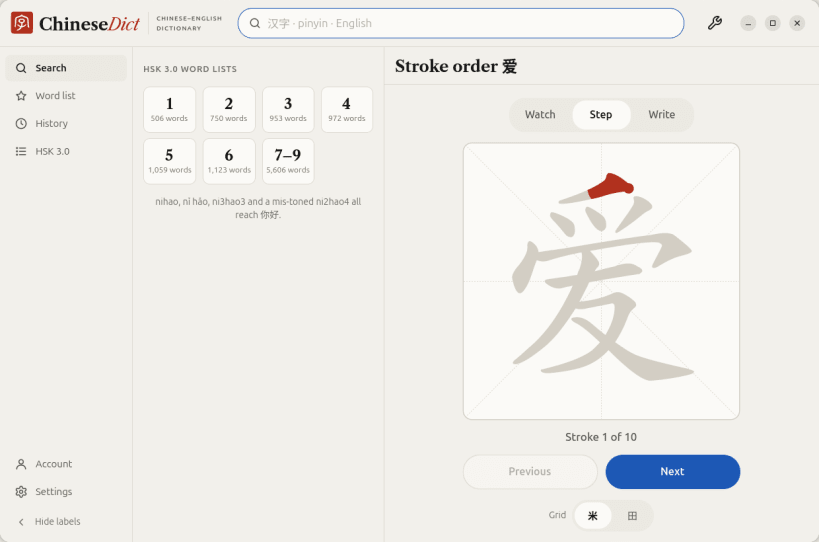
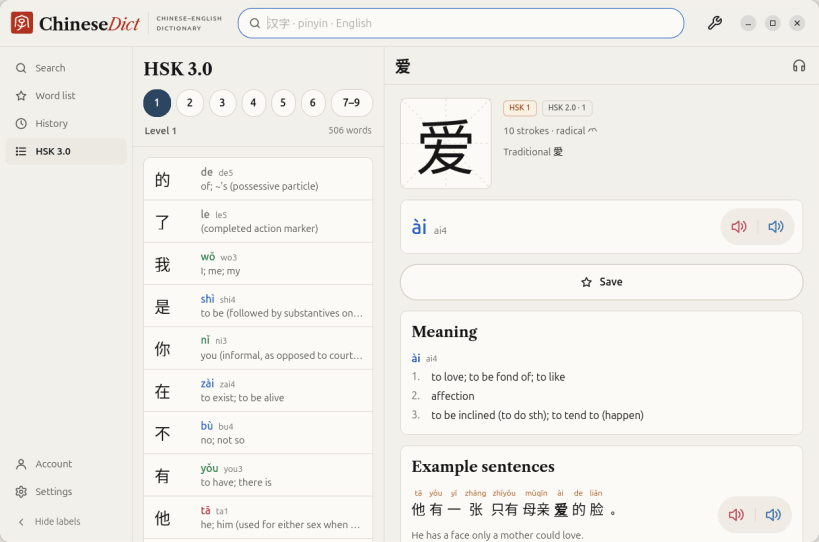
What an entry shows:
The results stay in a column beside the entry, so you can go down the list with ↑ and ↓ and read each entry without going back. Ctrl+F puts you in the search box from anywhere. Drag the line between the columns to make the list wider; hide the side bar's labels for more room. HSK 3.0 word lists for every level are one click from the search page.
Recordings, stroke order and ancient forms load from chinesedict.com the first time you open them, then stay on the computer. The snap is a 30 MB download (81 MB unpacked), most of it the dictionary.
Save any word with one click. Without an account the list stays on this computer. Sign in with a code sent to your email (no password) and the list and your lookup history are the same here, on chinesedict.com and in the phone apps.
Light and dark themes. No ads.
Dictionary data: CC-CEDICT (CC BY-SA 4.0). Example sentences: Tatoeba (CC BY 2.0 FR). Stroke order: hanzi-writer-data (Arphic Public License). Character components: Make Me a Hanzi (LGPL-3.0). HSK lists: complete-hsk-vocabulary (MIT). Ancient forms: Wikimedia Commons. Full credits are in the app under Settings › About.
You are about to open
Do you wish to proceed?
Thank you for your report. Information you provided will help us investigate further.
There was an error while sending your report. Please try again later.
Snaps are applications packaged with all their dependencies to run on all popular Linux distributions from a single build. They update automatically and roll back gracefully.
Snaps are discoverable and installable from the Snap Store, an app store with an audience of millions.
Snap can be installed from the command line on openSUSE Leap 15.x and Tumbleweed.
You need first add the snappy repository from the terminal. Choose the appropriate command depending on your installed openSUSE flavor.
Tumbleweed:
sudo zypper addrepo --refresh https://download.opensuse.org/repositories/system:/snappy/openSUSE_Tumbleweed snappy
Leap 15.x:
sudo zypper addrepo --refresh https://download.opensuse.org/repositories/system:/snappy/openSUSE_Leap_15.6 snappy
If needed, Swap out openSUSE_Leap_15. for, openSUSE_Leap_16.0 if you’re using a different version of openSUSE.
With the repository added, import its GPG key:
sudo zypper --gpg-auto-import-keys refresh
Finally, upgrade the package cache to include the new snappy repository:
sudo zypper dup --from snappy
Snap can now be installed with the following:
sudo zypper install snapd
You then need to either reboot, logout/login or source /etc/profile to have /snap/bin added to PATH.
Additionally, enable and start both the snapd and the snapd.apparmor services with the following commands:
sudo systemctl enable --now snapd
sudo systemctl enable --now snapd.apparmor
To install ChineseDict, simply use the following command:
sudo snap install chinesedict
Browse and find snaps from the convenience of your desktop using the snap store snap.
Interested to find out more about snaps? Want to publish your own application? Visit snapcraft.io now.