

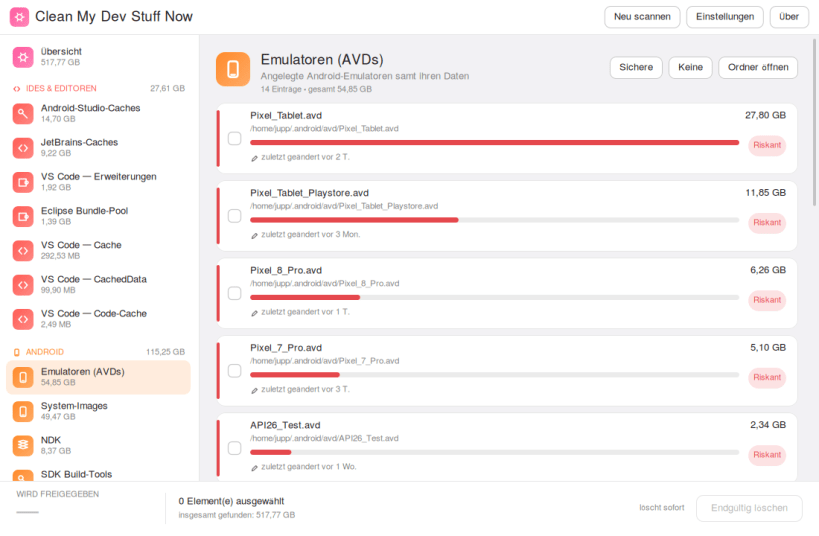

Development tools quietly fill your disk. Android SDKs and emulators, Gradle and Maven caches, npm and Yarn packages, IDE caches for every version you have ever run, and a dependency folder in every project you have ever built.
This shows you all of it at once: which area is the worst, which single folders are the biggest, and — for every entry — whether removing it costs you nothing, a download, or something you cannot get back.
What it does:
▶ ONE-TIME SETUP
sudo snap connect cleanmydevstuffnow:dev-caches
Developer caches live in hidden folders — ~/.gradle, ~/.npm, ~/.cache — and a confined app is kept out of those until you allow it. The command above grants access to those folders and nothing else; your keys, mail and documents stay out of reach. No reboot, just restart the app.
Supported systems:
Developed by Josef Sejrek / Budbrain Software Contact: cleanmydevstuffnow@budbrain.de | www.budbrain.de
You are about to open
Do you wish to proceed?
Thank you for your report. Information you provided will help us investigate further.
There was an error while sending your report. Please try again later.
Snaps are applications packaged with all their dependencies to run on all popular Linux distributions from a single build. They update automatically and roll back gracefully.
Snaps are discoverable and installable from the Snap Store, an app store with an audience of millions.
Snap can be installed from the command line on openSUSE Leap 15.x and Tumbleweed.
You need first add the snappy repository from the terminal. Choose the appropriate command depending on your installed openSUSE flavor.
Tumbleweed:
sudo zypper addrepo --refresh https://download.opensuse.org/repositories/system:/snappy/openSUSE_Tumbleweed snappy
Leap 15.x:
sudo zypper addrepo --refresh https://download.opensuse.org/repositories/system:/snappy/openSUSE_Leap_15.6 snappy
If needed, Swap out openSUSE_Leap_15. for, openSUSE_Leap_16.0 if you’re using a different version of openSUSE.
With the repository added, import its GPG key:
sudo zypper --gpg-auto-import-keys refresh
Finally, upgrade the package cache to include the new snappy repository:
sudo zypper dup --from snappy
Snap can now be installed with the following:
sudo zypper install snapd
You then need to either reboot, logout/login or source /etc/profile to have /snap/bin added to PATH.
Additionally, enable and start both the snapd and the snapd.apparmor services with the following commands:
sudo systemctl enable --now snapd
sudo systemctl enable --now snapd.apparmor
To install Clean My Dev Stuff Now, simply use the following command:
sudo snap install cleanmydevstuffnow
Browse and find snaps from the convenience of your desktop using the snap store snap.

Interested to find out more about snaps? Want to publish your own application? Visit snapcraft.io now.