
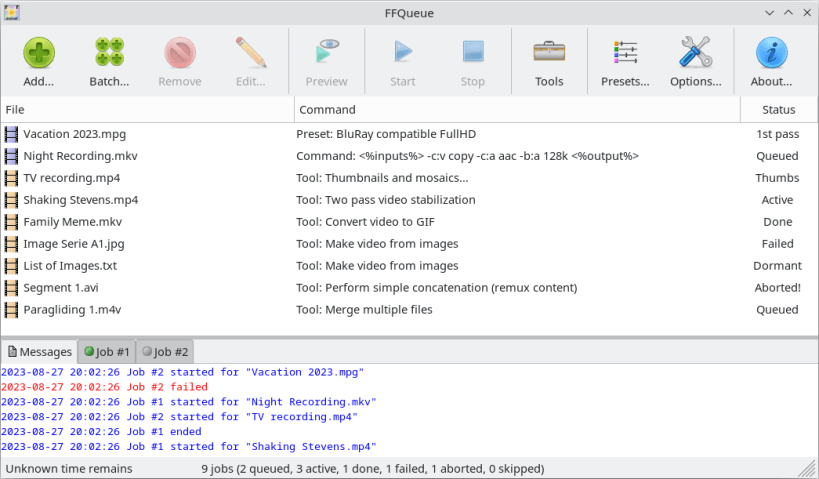
FFQueue is (yet another) graphical user interface for FFmpeg with comprehensive support for both the basic features but also the more advanced features like filtergraphs. FFQueue makes it easy to create multiple jobs and process them as a single queue.
About the releases:
If you cannot access content on secondary drives, and would like to do so, you may grant read+write access to all secondary drives with the command sudo snap connect ffqueue:removable-media. You may also use bind-mounts to grant read+write to a single folder on a secondary drive with the command sudo mount --bind /media/user-name/drive-name/folder-name /home/user-name/mount-point. If you only want to grant read access, use sudo mount -o bind,ro /media/user-name/drive-name/folder-name /home/user-name/mount-point.
Please report bugs! :-)
You are about to open
Do you wish to proceed?
Thank you for your report. Information you provided will help us investigate further.
There was an error while sending your report. Please try again later.
Snaps are applications packaged with all their dependencies to run on all popular Linux distributions from a single build. They update automatically and roll back gracefully.
Snaps are discoverable and installable from the Snap Store, an app store with an audience of millions.
Snap can be installed on Fedora from the command line:
sudo dnf install snapd
Either log out and back in again, or restart your system, to ensure snap’s paths are updated correctly.
To enable classic snap support, enter the following to create a symbolic link between /var/lib/snapd/snap and /snap:
sudo ln -s /var/lib/snapd/snap /snap
To install FFQueue, simply use the following command:
sudo snap install ffqueue
Browse and find snaps from the convenience of your desktop using the snap store snap.

Interested to find out more about snaps? Want to publish your own application? Visit snapcraft.io now.