
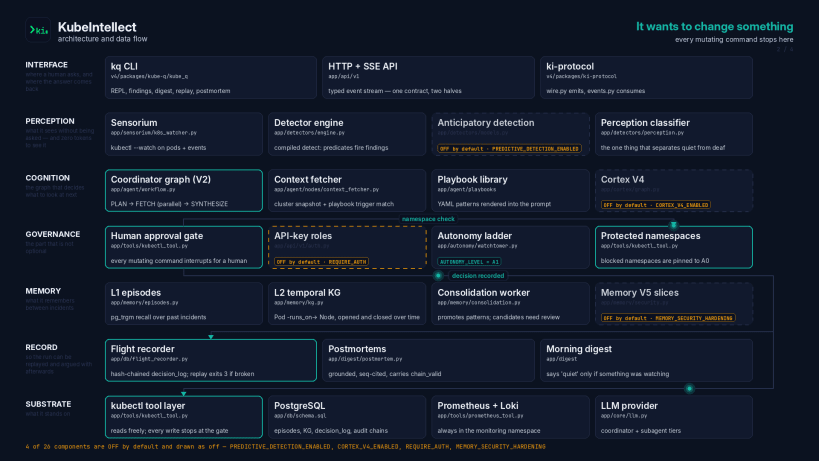
KubeIntellect is an AI agent platform for Kubernetes operations, and kq is
its terminal client: an interactive REPL that lets you query, debug and triage a
cluster in plain English.
This snap packages the client only. It talks over HTTPS to a KubeIntellect
server (self-hosted via the published container image, or any OpenAI /
Azure OpenAI compatible backend selected with --backend).
Highlights:
kq completion <shell>)After installing, connect the two personal-files interfaces so kq can read
your kubeconfig and keep its own state:
 sudo snap connect kubeintellect:dot-kube
 sudo snap connect kubeintellect:dot-kube-q
and, if you want the short command name:
sudo snap alias kubeintellect.kq kq
Point it at a backend with KUBE_Q_URL (and KUBE_Q_API_KEY where required),
then run kubeintellect. See https://github.com/MSKazemi/kubeintellect for the
server side and full documentation.
You are about to open
Do you wish to proceed?
Thank you for your report. Information you provided will help us investigate further.
There was an error while sending your report. Please try again later.
Snaps are applications packaged with all their dependencies to run on all popular Linux distributions from a single build. They update automatically and roll back gracefully.
Snaps are discoverable and installable from the Snap Store, an app store with an audience of millions.
On Arch Linux, snap can be installed from the Arch User Repository (AUR). The manual build process is the Arch-supported install method for AUR packages, and you’ll need the prerequisites installed before you can install any AUR package. You can then install snap with the following:
git clone https://aur.archlinux.org/snapd.git
cd snapd
makepkg -si
Once installed, the systemd unit that manages the main snap communication socket needs to be enabled:
sudo systemctl enable --now snapd.socket
If AppArmor is enabled in your system, enable the service which loads AppArmor profiles for snaps:
sudo systemctl enable --now snapd.apparmor.service
To enable classic snap support, enter the following to create a symbolic link between /var/lib/snapd/snap and /snap:
sudo ln -s /var/lib/snapd/snap /snap
Either log out and back in again, or restart your system, to ensure snap’s paths are updated correctly.
To install KubeIntellect (kq), simply use the following command:
sudo snap install kubeintellect
Browse and find snaps from the convenience of your desktop using the snap store snap.

Interested to find out more about snaps? Want to publish your own application? Visit snapcraft.io now.