
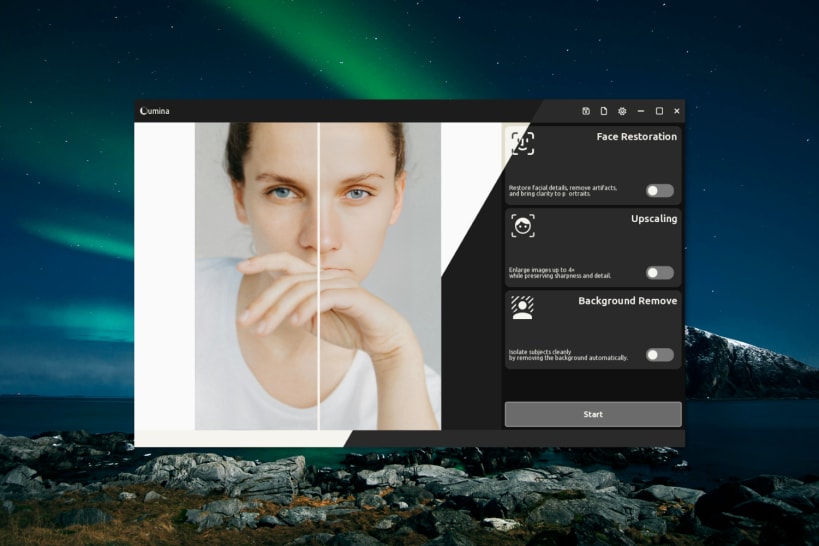
Lumina – AI-Powered Face & Photo Enhancer
Lumina is a fast, lightweight desktop app that enhances portraits and cleans up images using advanced AI models. Powered by real-time deep learning, it offers:
Model Downloads
When run for the first time Lumina will download each required model files from [Releases page](https://github.com/RameshRavone/lumina-dev/releases) of the Lumina Dev GitHub repository and place them in $SNAP_DIR_COMMON/.cache/lumina/models folder
$SNAP_DIR_COMMON = $HOME/snap/lumina/common (Usually)
Installation
Install Lumina on any Linux distribution that supports Snap with: snap install lumina
How to use
Lumina a support both CLI-Terminal and GUI-Editor mode
GUI  -  lumina editor --vsync
CLI   -  lumina cli -i <INPUT IMAGE> -o <OUTPUT> --actions face upscale`
Bug Reports and Feedback
Found a bug or have a feature request?
Please submit issues via our public [Issue Tracker Repository](https://github.com/RameshRavone/lumina-dev/issues).
Built natively with performance in mind, Lumina runs entirely offline — no internet connection needed. Perfect for photographers, designers, or anyone looking to upscale or restore images with ease.
You are about to open
Do you wish to proceed?
Thank you for your report. Information you provided will help us investigate further.
There was an error while sending your report. Please try again later.
Snaps are applications packaged with all their dependencies to run on all popular Linux distributions from a single build. They update automatically and roll back gracefully.
Snaps are discoverable and installable from the Snap Store, an app store with an audience of millions.
Snap is available for Red Hat Enterprise Linux (RHEL) 8 and RHEL 7, from the 7.6 release onward.
The packages for RHEL 7, RHEL 8, and RHEL 9 are in each distribution’s respective Extra Packages for Enterprise Linux (EPEL) repository. The instructions for adding this repository diverge slightly between RHEL 7, RHEL 8 and RHEL 9, which is why they’re listed separately below.
The EPEL repository can be added to RHEL 9 with the following command:
sudo dnf install https://dl.fedoraproject.org/pub/epel/epel-release-latest-9.noarch.rpm
sudo dnf upgrade
The EPEL repository can be added to RHEL 8 with the following command:
sudo dnf install https://dl.fedoraproject.org/pub/epel/epel-release-latest-8.noarch.rpm
sudo dnf upgrade
The EPEL repository can be added to RHEL 7 with the following command:
sudo rpm -ivh https://dl.fedoraproject.org/pub/epel/epel-release-latest-7.noarch.rpm
Adding the optional and extras repositories is also recommended:
sudo subscription-manager repos --enable "rhel-*-optional-rpms" --enable "rhel-*-extras-rpms"
sudo yum update
Snap can now be installed as follows:
sudo yum install snapd
Once installed, the systemd unit that manages the main snap communication socket needs to be enabled:
sudo systemctl enable --now snapd.socket
To enable classic snap support, enter the following to create a symbolic link between /var/lib/snapd/snap and /snap:
sudo ln -s /var/lib/snapd/snap /snap
Either log out and back in again or restart your system to ensure snap’s paths are updated correctly.
To install Lumina, simply use the following command:
sudo snap install lumina --edge
Browse and find snaps from the convenience of your desktop using the snap store snap.

Interested to find out more about snaps? Want to publish your own application? Visit snapcraft.io now.