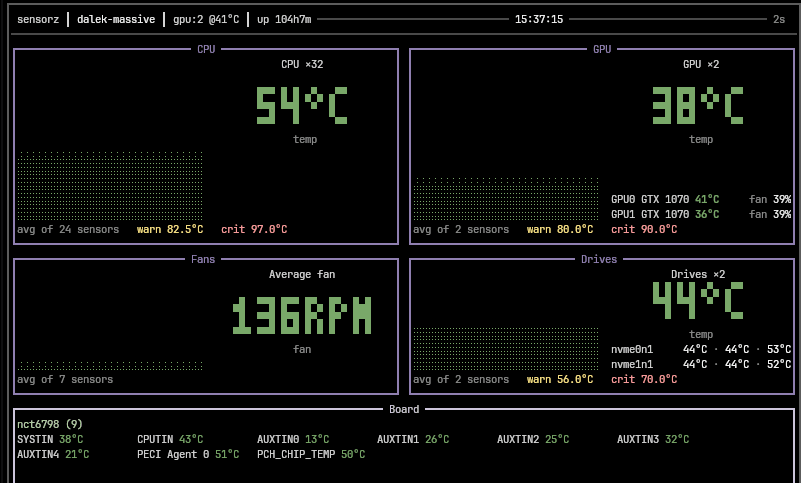
sensorz shows how hot your machine is and whether its fans are still spinning.
One box per class of sensor - CPU, GPU, drives, and the motherboard thermistors - each with one large figure, its history as a graph, and the thresholds it is judged against. Where a machine reports many of a thing, the readings are averaged rather than listed: sixteen cores and eight case fans are four numbers, not twenty-four.
It reads the kernel's hardware monitoring interface directly, so it works with whatever drivers the machine already has, and it reports temperatures and fan speeds and nothing else.
Thank you for your report. Information you provided will help us investigate further.
There was an error while sending your report. Please try again later.
Snaps are applications packaged with all their dependencies to run on all popular Linux distributions from a single build. They update automatically and roll back gracefully.
Snaps are discoverable and installable from the Snap Store, an app store with an audience of millions.
Snap is available for CentOS 7.6+, and Red Hat Enterprise Linux 7.6+, from the Extra Packages for Enterprise Linux (EPEL) repository. The EPEL repository can be added to your system with the following command:
sudo yum install epel-release
Snap can now be installed as follows:
sudo yum install snapd
Once installed, the systemd unit that manages the main snap communication socket needs to be enabled:
sudo systemctl enable --now snapd.socket
To enable classic snap support, enter the following to create a symbolic link between /var/lib/snapd/snap and /snap:
sudo ln -s /var/lib/snapd/snap /snap
Either log out and back in again, or restart your system, to ensure snap’s paths are updated correctly.
To install sensorz — Temperature and Fan Monitor, simply use the following command:
sudo snap install sensorz
Browse and find snaps from the convenience of your desktop using the snap store snap.

Interested to find out more about snaps? Want to publish your own application? Visit snapcraft.io now.