
A library card that never expires.
First, the things that matter: • Free, with no subscription and no account. The whole library and every reading feature, on the device you install it on. No "two free chapters, then pay". • No ads. Not in the free version, not in any other. We checked. • Your reading is your business. No trackers, nothing sold, nobody reading over your shoulder. • Apps for every phone, tablet and computer. Keeping them in sync is the one thing that costs money — more on that at the end.
Now, the books.
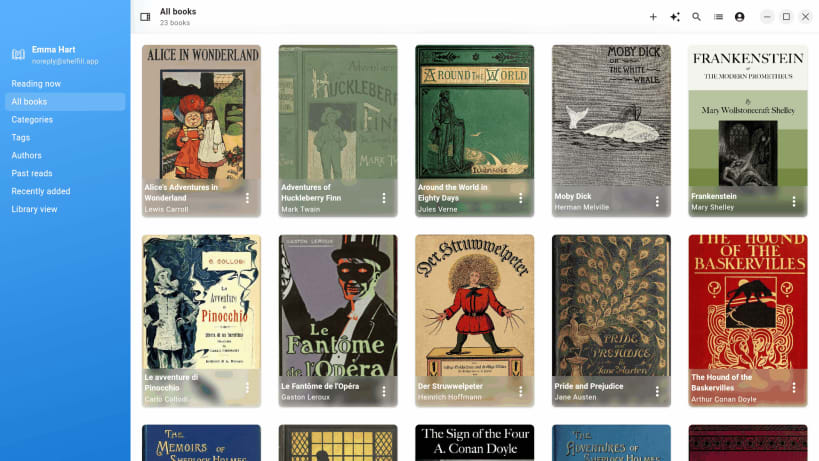
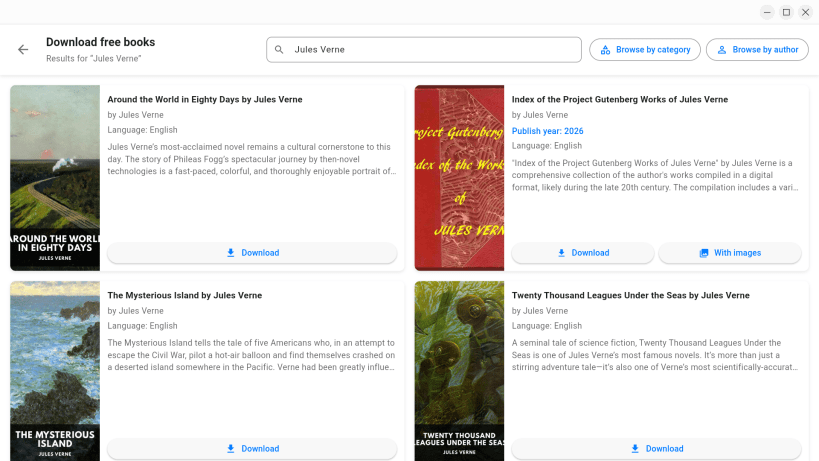
SHELFill puts more than 70,000 free books on your shelf: the classics you meant to read in school, the ones you told people you'd read, and a few thousand you've never heard of. Pick one and start.
Got books of your own? Bring them. EPUB, PDF and Word files — from your files, your mail or a link — land on the same shelf as everything else, so your library is finally in one place. Which is more than can be said for the one at home.
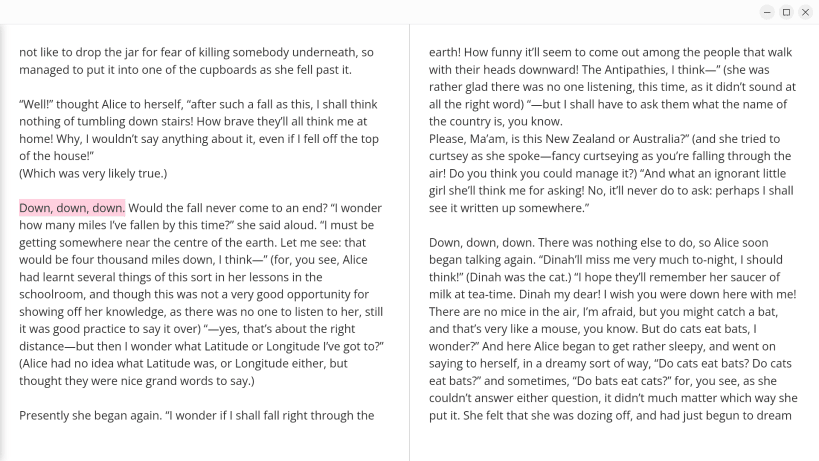
THE READER • Fonts, margins, line spacing and page colors, because everyone has opinions about margins • One page on a phone, two side by side on a tablet • Hold a word to look it up. Save it, and it comes back as a flashcard until it sticks
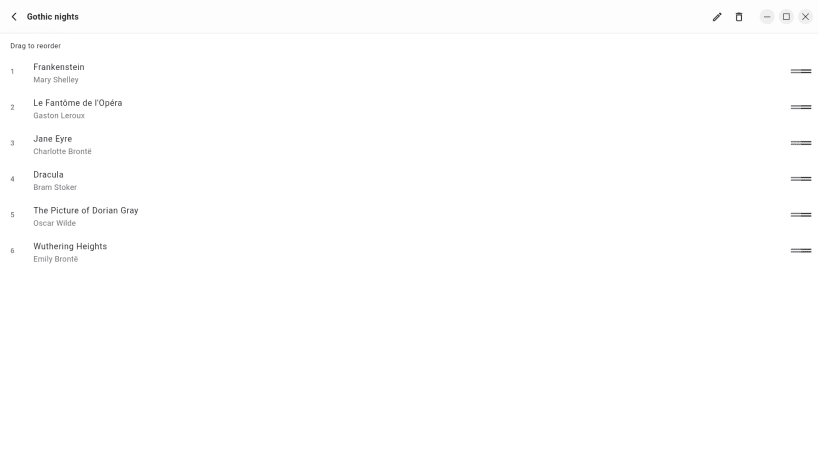
THE SHELF • Shelves, tags, categories and series, so "the one with the whale" is always one tap away • Bookmarks, highlights in five colors, and notes you can export • Every book reopens exactly where you left it • Browse other public libraries too (OPDS catalogs), if 70,000 books somehow aren't enough
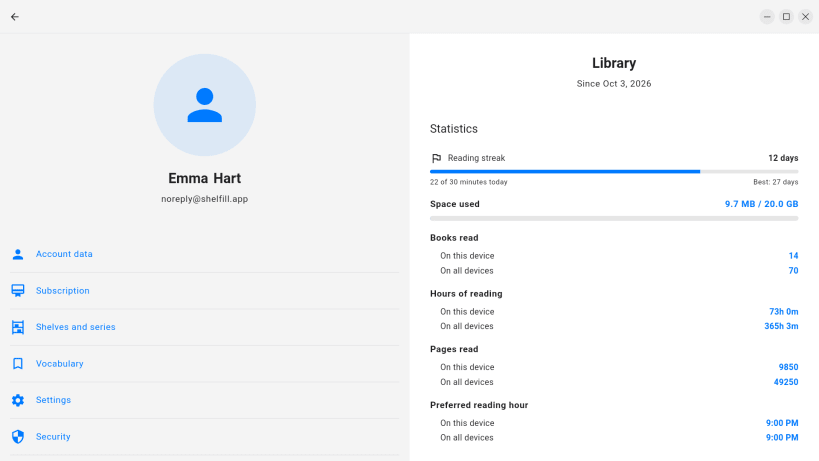
THE HABIT • A daily goal in minutes or pages, and a streak you'll be surprisingly unwilling to break • Statistics: what you read, how much, and at what hour you tend to do it (later than you think)
KEPT YOURS • Lock the app with a PIN • Two-step sign-in for your account, if you have one
FOR PEOPLE WITH MORE THAN ONE SCREEN, OR A HISTORY WITH PHONES Everything above is free and stays free. A subscription adds the things that need a server behind them:
• Sync. Your books, highlights, notes, bookmarks, saved words, your place in every book and your reading statistics follow you from phone to tablet to computer. Start a chapter on the train, carry on at the kitchen table, finish in bed — same page, every time. • A safety net. A phone that breaks, drowns or wanders off takes nothing with it. Sign in on the next one and the whole library is back, down to the page you were on and the streak you were keeping. • Cloud space for your own books — 5, 10 or 20 GB, depending on the plan — so the files you imported are kept safe and turn up on every device without any copying around. • The web app. Open my.shelfill.app in any browser, sign in, and your shelf is there: on a work laptop, a borrowed computer, anywhere with a screen and no install. • Statistics across devices: hours read, pages, books finished — the totals from all your devices in one place, not just the one in your hand. • Three AI helpers, with a monthly allowance that grows with the plan: describe what you're in the mood for and get a handful of suggestions with a reason for each; translate a paragraph into the language you read in, tone intact; or ask what a passage means and get a plain-language explanation that knows which book it's reading.
Three plans — Shelf, Bookcase and Library — that differ only in storage and AI allowance. Pick one, change your mind later, cancel whenever; your books stay on your devices either way.
Your shelf is ready whenever you are.
You are about to open
Do you wish to proceed?
Thank you for your report. Information you provided will help us investigate further.
There was an error while sending your report. Please try again later.
Snaps are applications packaged with all their dependencies to run on all popular Linux distributions from a single build. They update automatically and roll back gracefully.
Snaps are discoverable and installable from the Snap Store, an app store with an audience of millions.
Snap is available for Red Hat Enterprise Linux (RHEL) 8 and RHEL 7, from the 7.6 release onward.
The packages for RHEL 7, RHEL 8, and RHEL 9 are in each distribution’s respective Extra Packages for Enterprise Linux (EPEL) repository. The instructions for adding this repository diverge slightly between RHEL 7, RHEL 8 and RHEL 9, which is why they’re listed separately below.
The EPEL repository can be added to RHEL 9 with the following command:
sudo dnf install https://dl.fedoraproject.org/pub/epel/epel-release-latest-9.noarch.rpm
sudo dnf upgrade
The EPEL repository can be added to RHEL 8 with the following command:
sudo dnf install https://dl.fedoraproject.org/pub/epel/epel-release-latest-8.noarch.rpm
sudo dnf upgrade
The EPEL repository can be added to RHEL 7 with the following command:
sudo rpm -ivh https://dl.fedoraproject.org/pub/epel/epel-release-latest-7.noarch.rpm
Adding the optional and extras repositories is also recommended:
sudo subscription-manager repos --enable "rhel-*-optional-rpms" --enable "rhel-*-extras-rpms"
sudo yum update
Snap can now be installed as follows:
sudo yum install snapd
Once installed, the systemd unit that manages the main snap communication socket needs to be enabled:
sudo systemctl enable --now snapd.socket
To enable classic snap support, enter the following to create a symbolic link between /var/lib/snapd/snap and /snap:
sudo ln -s /var/lib/snapd/snap /snap
Either log out and back in again or restart your system to ensure snap’s paths are updated correctly.
To install SHELFill - Books & eBook Reader, simply use the following command:
sudo snap install shelfill

Browse and find snaps from the convenience of your desktop using the snap store snap.

Interested to find out more about snaps? Want to publish your own application? Visit snapcraft.io now.