
Screencast Keystroke HUD (screencast-key-hud)
Install latest/stable of Screencast Keystroke HUD
Ubuntu 16.04 or later?
Make sure snap support is enabled in your Desktop store.
Install using the command line
sudo snap install screencast-key-hudDon't have snapd? Get set up for snaps.
Details for Screencast Keystroke HUD
Package name
- screencast-key-hud
License
- MIT
Last updated
- Yesterday - latest/stable
Websites
Contact
External link warning
You are about to open
Do you wish to proceed?
Report a Snap Store violation
Report Screencast Keystroke HUD for a Snap Store violation
Snap Store Violation Report submitted successfully
Thank you for your report. Information you provided will help us investigate further.
Error submitting report
There was an error while sending your report. Please try again later.
Share this snap
Generate an embeddable card to be shared on external websites.
Click-through X11 screencast keystroke display overlay with chord pills
Screencast Keystroke HUD is an independent open-source Linux alternative to Carnac for real-time screencast keystroke display overlay on X11 desktops. It is not affiliated with, sponsored by, or endorsed by Code52 or Carnac.
FEATURES
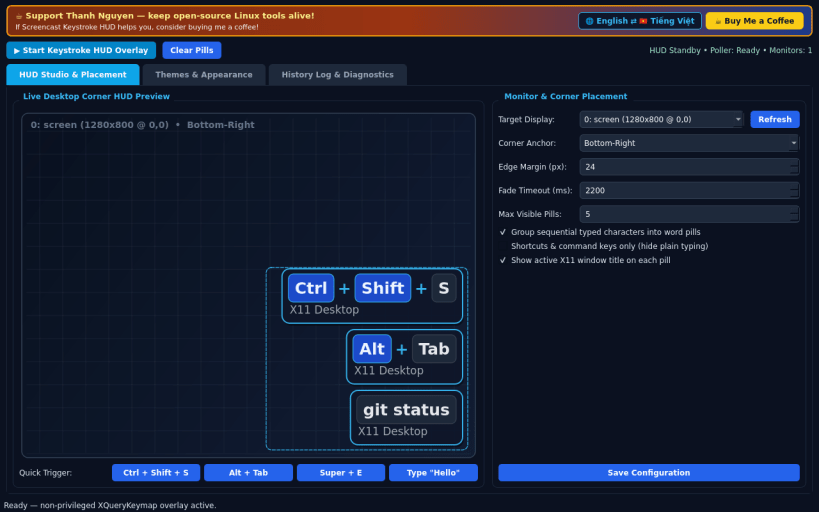
- Animated Keystroke Chord Pills: Polls X11 keymap and pointer state using non-privileged XQueryKeymap to render crisp modifier and chord pills (Ctrl + Shift + S, Alt + Tab) on a translucent Always-on-Top overlay.
- Click-Through XShape Window: Transparent overlay passes pointer clicks through to underlying windows via XShape Input masks without interrupting presentations or live coding demos.
- Multi-Monitor and Corner Placement: Pick any display detected via RandR or Xinerama and anchor the HUD to any corner with configurable edge margins and fade timeout.
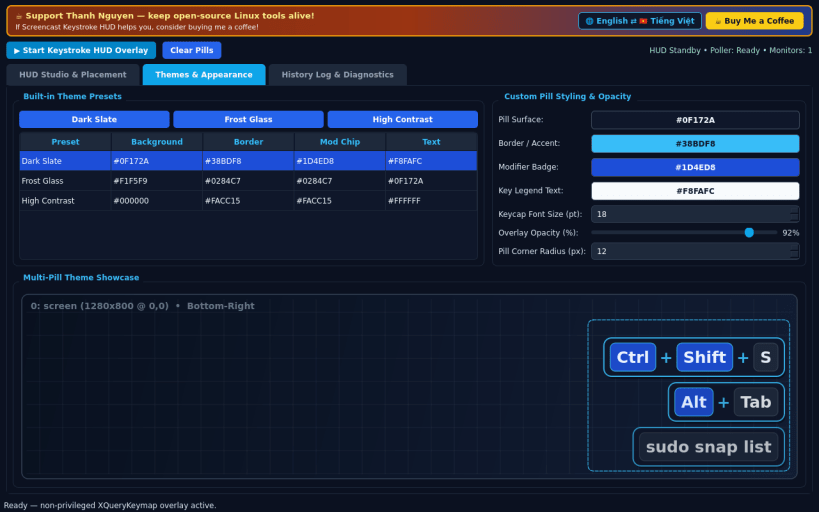
- Theme Presets and Grouping: Switch between Dark Slate, Frost Glass, and High Contrast presets, customize colors and opacity, or group sequential typed characters into clean tutorial banners.
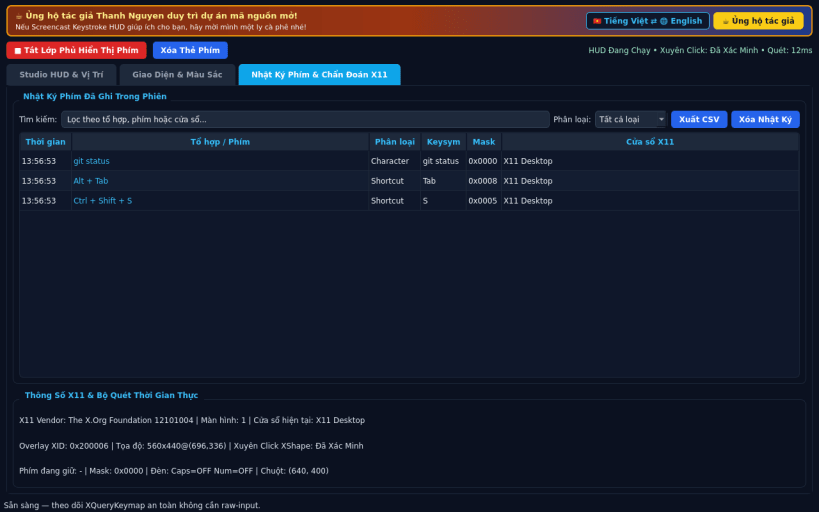
- Tutorial Keystroke History Log: Inspect captured chords alongside active window titles, filter by category, and export UTF-8 CSV logs.
SUPPORT & DONATE
- Created by Thanh Nguyen — https://buymeacoffee.com/thanhnv128b
| Revision | Channel | Version | Build | Commit | Download SBOM |
|---|
The build and commit information is derived from build infrastructure records.
Install Screencast Keystroke HUD on your Linux distribution
Choose your Linux distribution to get detailed installation instructions. If yours is not shown, get more details on the installing snapd documentation.


