
Keyboard Shortcut Coach HUD (shortcut-habit-coach)
Install latest/stable of Keyboard Shortcut Coach HUD
Ubuntu 16.04 or later?
Make sure snap support is enabled in your Desktop store.
Install using the command line
sudo snap install shortcut-habit-coachDon't have snapd? Get set up for snaps.
Details for Keyboard Shortcut Coach HUD
Package name
- shortcut-habit-coach
License
- MIT
Last updated
- 14 November 2026 - latest/stable
Websites
Contact
External link warning
You are about to open
Do you wish to proceed?
Report a Snap Store violation
Report Keyboard Shortcut Coach HUD for a Snap Store violation
Snap Store Violation Report submitted successfully
Thank you for your report. Information you provided will help us investigate further.
Error submitting report
There was an error while sending your report. Please try again later.
Share this snap
Generate an embeddable card to be shared on external websites.
Context-aware X11 keyboard shortcut coach HUD and click habit analytics
Keyboard Shortcut Coach HUD is an independent open-source Linux X11 desktop coaching utility inspired by KeyParrot. Disclaimer: This project is an independent open-source tool and is not affiliated with, sponsored by, or endorsed by KeyParrot or its authors.
FEATURES
- Privacy-Safe Click Cadence Coach: Observes active X11 window class and pointer click repetition without storing typed characters, popping up a translucent Always-on-Top click-through coaching toast with the faster keyboard shortcut for that application.
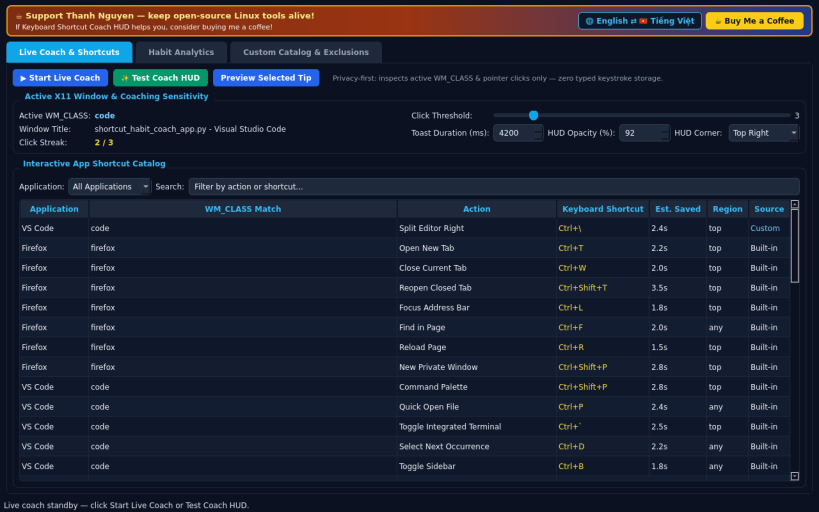
- Interactive App Shortcut Catalog: Includes built-in time-saving shortcut references for Firefox, VS Code, LibreOffice, Files, Terminal, GIMP, and General Desktop workflows with live HUD preview testing.
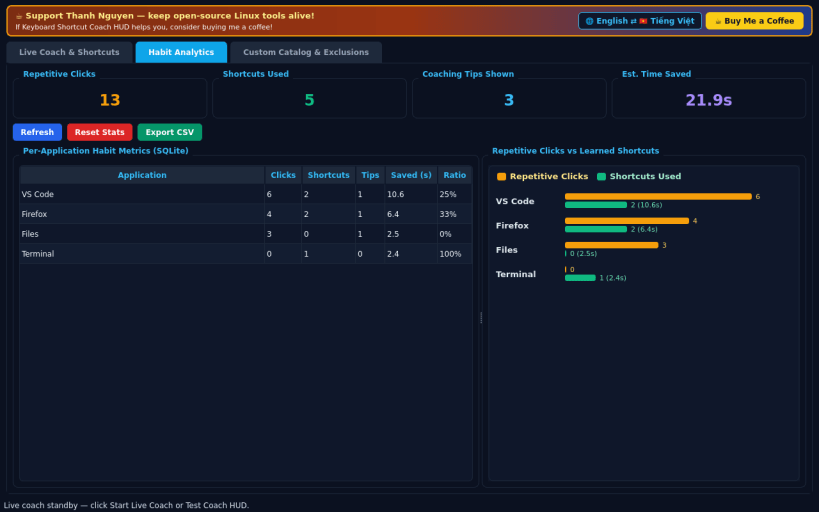
- Habit Analytics Dashboard: Tracks repetitive pointer clicks, learned shortcuts, coaching tips shown, and estimated seconds saved per app in local SQLite storage with visual bar charts and CSV export.
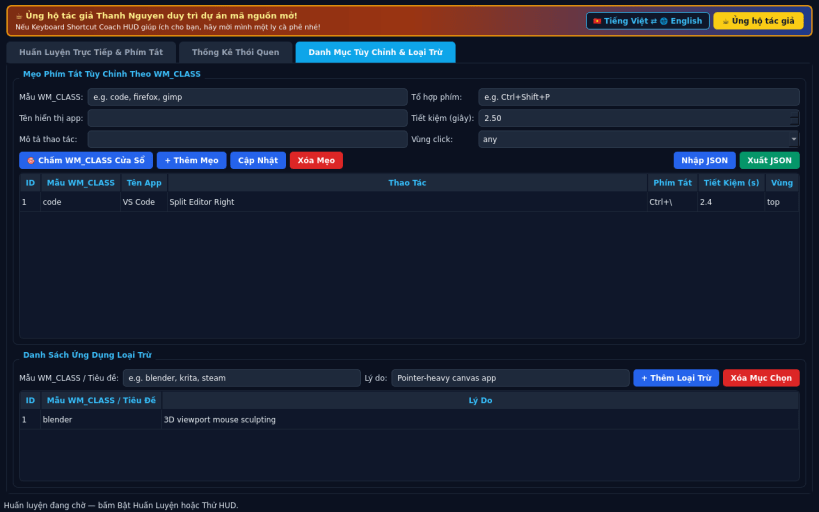
- Custom Catalog and Exclusions: Pick any X11 window class, define custom shortcut coaching rules, manage excluded applications, and import or export portable JSON profiles.
SUPPORT & DONATE
- Created by Thanh Nguyen — https://buymeacoffee.com/thanhnv128b
| Revision | Channel | Version | Build | Commit | Download SBOM |
|---|
The build and commit information is derived from build infrastructure records.
Install Keyboard Shortcut Coach HUD on your Linux distribution
Choose your Linux distribution to get detailed installation instructions. If yours is not shown, get more details on the installing snapd documentation.


