
Install latest/stable of Kula
Ubuntu 16.04 or later?
Make sure snap support is enabled in your Desktop store.
Details for Kula
Package name
- kula
License
- AGPL-3.0-only
Last updated
- 30 September 2026 - latest/stable
Websites
Contact
Donations
Source code
Report a bug
External link warning
You are about to open
Do you wish to proceed?
Report a Snap Store violation
Report Kula for a Snap Store violation
Snap Store Violation Report submitted successfully
Thank you for your report. Information you provided will help us investigate further.
Error submitting report
There was an error while sending your report. Please try again later.
Share this snap
Generate an embeddable card to be shared on external websites.
Lightweight, self-contained Linux server monitoring tool
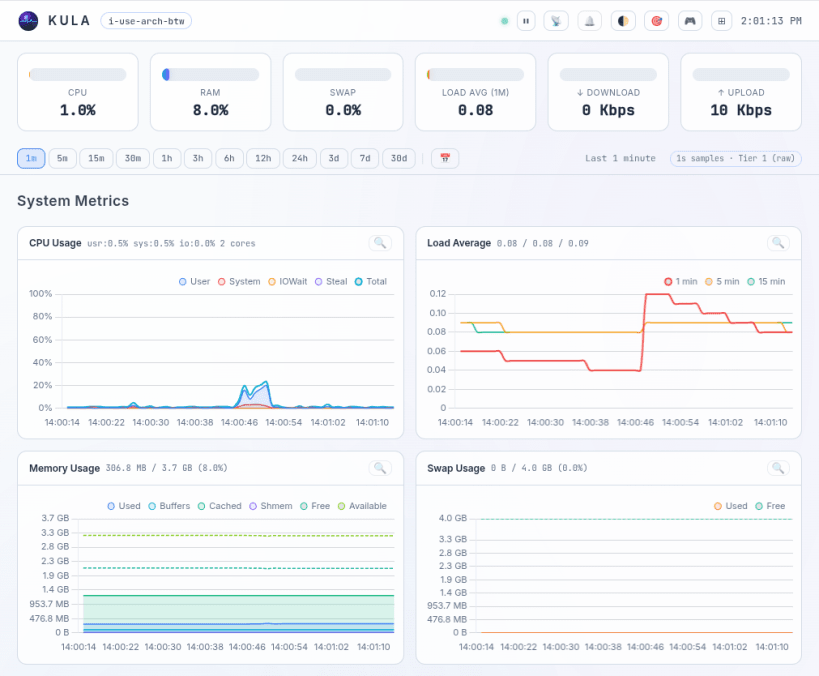
Kula is a lightweight, single-binary Linux server monitor. It collects system metrics every second straight from /proc and /sys, stores them in a built-in tiered ring-buffer engine, and serves them over a real-time web UI dashboard and a terminal TUI. Zero external dependencies, no external database — just install and go.
Collected metrics include CPU, GPU, load, memory, swap, network, disk I/O and usage, thermals, battery, processes, containers (Docker/podman/cgroups) and application probes (PostgreSQL, MySQL/MariaDB, nginx, apache2).
This snap uses STRICT confinement. After installing, connect the observation interfaces so Kula can read system-wide metrics:
 sudo snap connect kula:system-observe
 sudo snap connect kula:hardware-observe
 sudo snap connect kula:mount-observe
 sudo snap connect kula:network-observe
 sudo snap connect kula:docker        # optional: Docker collector
The daemon starts automatically and listens on http://localhost:27960 by
default. Edit /var/snap/kula/current/config.yaml and run
sudo snap restart kula.daemon to apply changes.
| Revision | Channel | Version | Build | Commit | Download SBOM |
|---|
The build and commit information is derived from build infrastructure records.
Install Kula on your Linux distribution
Choose your Linux distribution to get detailed installation instructions. If yours is not shown, get more details on the installing snapd documentation.