

Puter
Install latest/stable of Puter
Ubuntu 16.04 or later?
Make sure snap support is enabled in your Desktop store.
Details for Puter
Package name
- puter
License
- AGPL-3.0-only
Last updated
- 3 November 2026 - latest/stable
- 3 November 2026 - latest/candidate
Websites
Contact
Source code
Report a bug
External link warning
You are about to open
Do you wish to proceed?
Report a Snap Store violation
Report Puter for a Snap Store violation
Snap Store Violation Report submitted successfully
Thank you for your report. Information you provided will help us investigate further.
Error submitting report
There was an error while sending your report. Please try again later.
Share this snap
Generate an embeddable card to be shared on external websites.
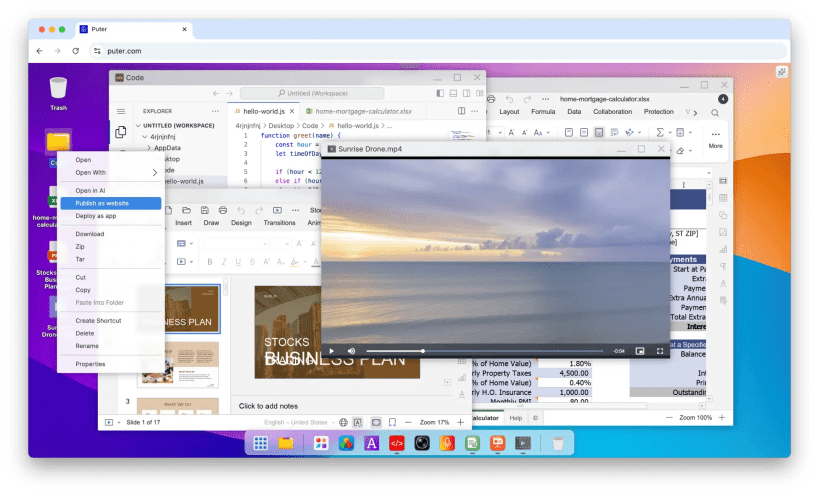
Self-hosted internet computer, a desktop environment in your browser
Puter is a self-hosted web desktop: a desktop, file manager, text editor and app store in the browser, with cloud storage for your files, an app and website hosting platform, and the Puter.js API for building apps on top of it.
This snap runs the self-hosted server with upstream's built-in storage: an SQLite database and local file storage, with no other services to install.
Getting started
The service starts right after installation and listens on 127.0.0.1:4100 (this machine only). Open http://puter.localhost:4100 and sign in as admin. The generated password is printed in the service log until you change it:
sudo snap logs puter -n=all | grep "password for admin"
Settings
sudo snap set puter port=4100 host=127.0.0.1
sudo snap set puter domain=puter.example.com
sudo snap set puter protocol=https pub-port=443
Puter routes by subdomain (api.<domain>, site.<domain>, app.<domain>), so a domain other than puter.localhost needs wildcard DNS. Other upstream settings go in /var/snap/puter/common/config.json.
| Revision | Channel | Version | Build | Commit | Download SBOM |
|---|
The build and commit information is derived from build infrastructure records.
Install Puter on your Linux distribution
Choose your Linux distribution to get detailed installation instructions. If yours is not shown, get more details on the installing snapd documentation.


