
OpalaTex
Install latest/stable of OpalaTex
Ubuntu 16.04 or later?
Make sure snap support is enabled in your Desktop store.
Details for OpalaTex
Package name
- opalatex
License
- MIT
Last updated
- 16 October 2026 - latest/stable
- 25 September 2026 - latest/candidate
Websites
Contact
Donations
Source code
Report a bug
External link warning
You are about to open
Do you wish to proceed?
Report a Snap Store violation
Report OpalaTex for a Snap Store violation
Snap Store Violation Report submitted successfully
Thank you for your report. Information you provided will help us investigate further.
Error submitting report
There was an error while sending your report. Please try again later.
Share this snap
Generate an embeddable card to be shared on external websites.
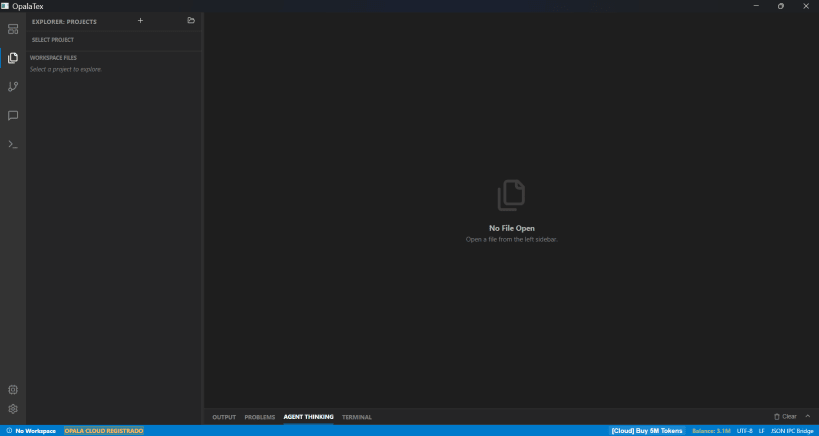
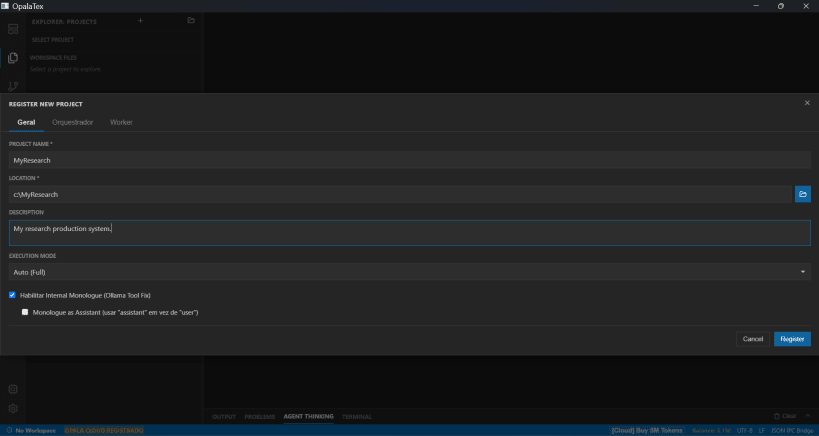
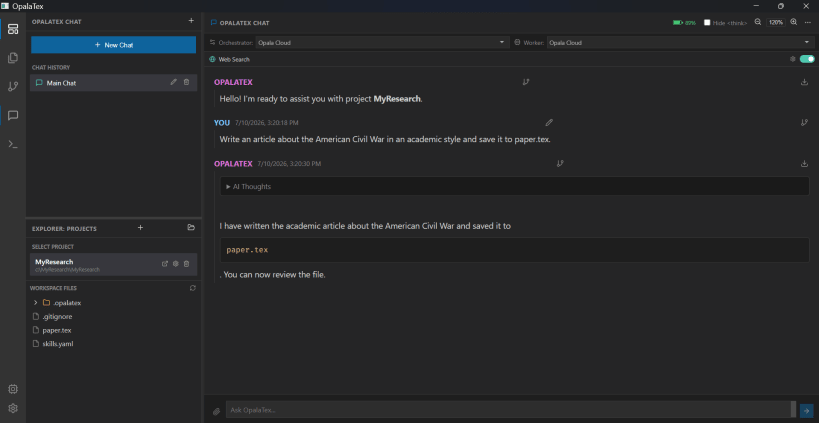
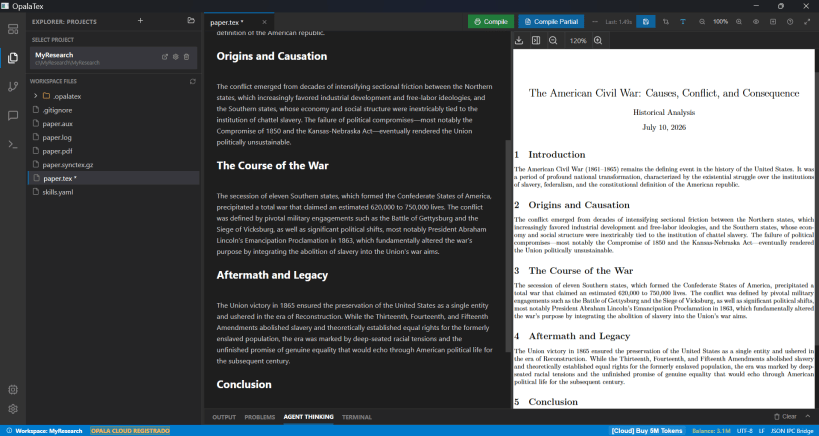
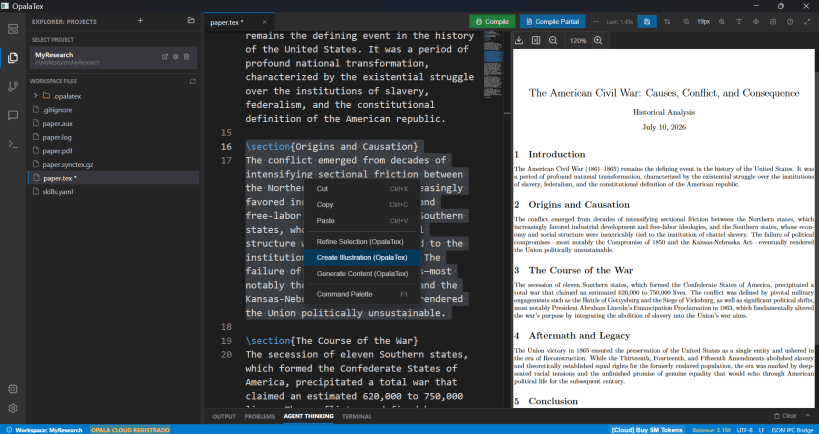
AI-assisted LaTeX editor and project IDE
# OpalaTex: The Unified Academic & R&D Computing Suite
OpalaTex is a free, open-source research and development platform designed to bridge technical writing, scientific computing, and artificial intelligence. Built specifically for researchers, data scientists, and engineers, OpalaTex eliminates workflow fragmentation by combining manuscript authoring, experimental code generation, data visualization, and private AI into a single, cohesive ecosystem.
## Key Features
### 1. Academic Authoring & Document Preparation
- Comprehensive LaTeX Environment: Write and compile papers, theses, technical reports, and books with native support for complex mathematics, cross-referencing, and BibTeX/biber management.
- Beamer Slide Decks: Build dynamic, modular, and conference-ready presentations with zero context switching.
- Google Drive Cloud Sync: Seamlessly sync your projects, manuscripts, and assets across multiple workstations with integrated Google Drive backup and synchronization.
### 2. Scientific Computing, Experiments & Data Visualization
- Research-Focused Code Generation: Prompt AI to generate, refactor, and audit simulation pipelines, data manipulation routines, and numerical modeling scripts (Python, R, Julia, C++).
- Publication-Grade Data Visualization: Create publication-ready statistical plots, vector figures, and architectural diagrams (Matplotlib, Seaborn, TikZ, ggplot2) styled to match your paper's typography.
- Reproducible Research Pipelines: Connect data, analysis scripts, generated figures, and the compiled document within one unified workspace to ensure complete computational reproducibility.
### 3. Flexible AI Assistance (Local Privacy & Cloud Scale)
- Local AI via Ollama: Run open-weights models directly on your hardware. Analyze drafts, synthesize literature, and proofread papers with full assurance that confidential data and unpublished intellectual property never leave your machine.
- Literature Review & Article Analysis: Interrogate research papers, extract key equations, and summarize methodologies with context-aware document analysis.
- Broad Cloud Connectivity: Seamlessly switch to external providers when extra scale is needed, featuring native support for Ollama Cloud, OpenRouter, and any standard OpenAI-compatible API.
## The OpalaTex Workflow
```text [Raw Data & Scientific Hypotheses] ↓ [OpalaTex Assistant] → Generates analysis & simulation scripts ↓ [Data Visualization] → Renders publication-grade TikZ / Matplotlib plots ↓ [Manuscript Drafting] → Compiles LaTeX papers & Beamer slide decks ↓ [Google Drive Sync] → Automatic cloud backup & cross-device sync
```
## Why OpalaTex?
Traditional scientific writing treats coding, visualization, and typesetting as disconnected tasks spread across terminals, notebooks, and text editors. OpalaTex closes this gap by unifying computation with document production, providing a modern, private, and reproducible environment for the future of academic research.
## Tested Models
Not all models work the same way. Small models, such as LFM 2.6B (quantized or not), do extraordinary things for their size, like searching the web and generating coherent text and LaTeX. However, they are terrible at correcting LaTeX. Large models, like DeepSeek-v4.1-flash, GLM 5.3, GLM 5.3 Flash, Kimi K3, Gemini 3.8 Flash, GPT 5.6, and others at the same tier, are very good at almost every task in the research workflow, from generating computational experiments to writing and correcting LaTeX. Quantized intermediate models, like Ollama's Gemma4 26B running locally, achieve good results in text and LaTeX generation, and even in code generation. However, the VRAM requirements needed to expand the local context window can severely limit their tasks without increasing hardware investment costs. The best open model was DeepSeek-v4.1-flash in all internal benchmarks.
| Revision | Channel | Version | Build | Commit | Download SBOM |
|---|
The build and commit information is derived from build infrastructure records.
Install OpalaTex on your Linux distribution
Choose your Linux distribution to get detailed installation instructions. If yours is not shown, get more details on the installing snapd documentation.